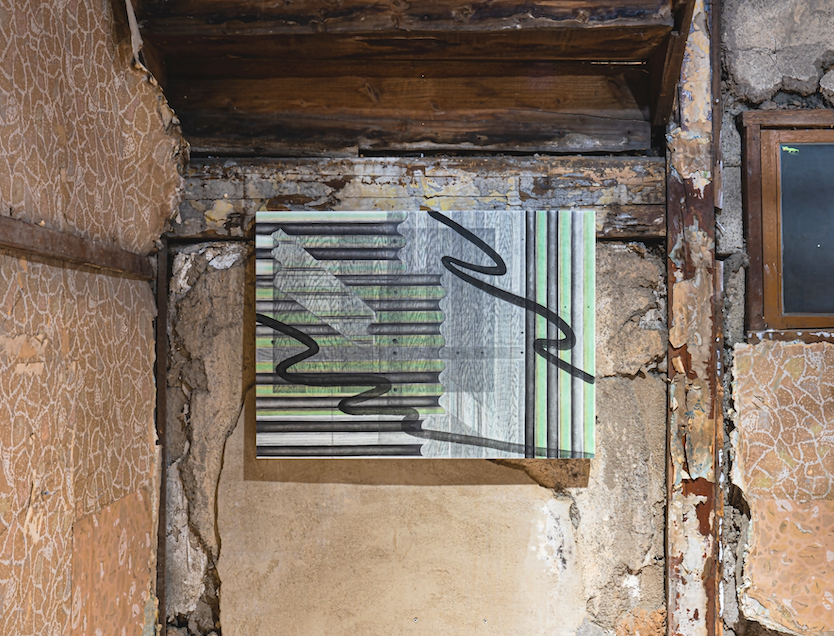
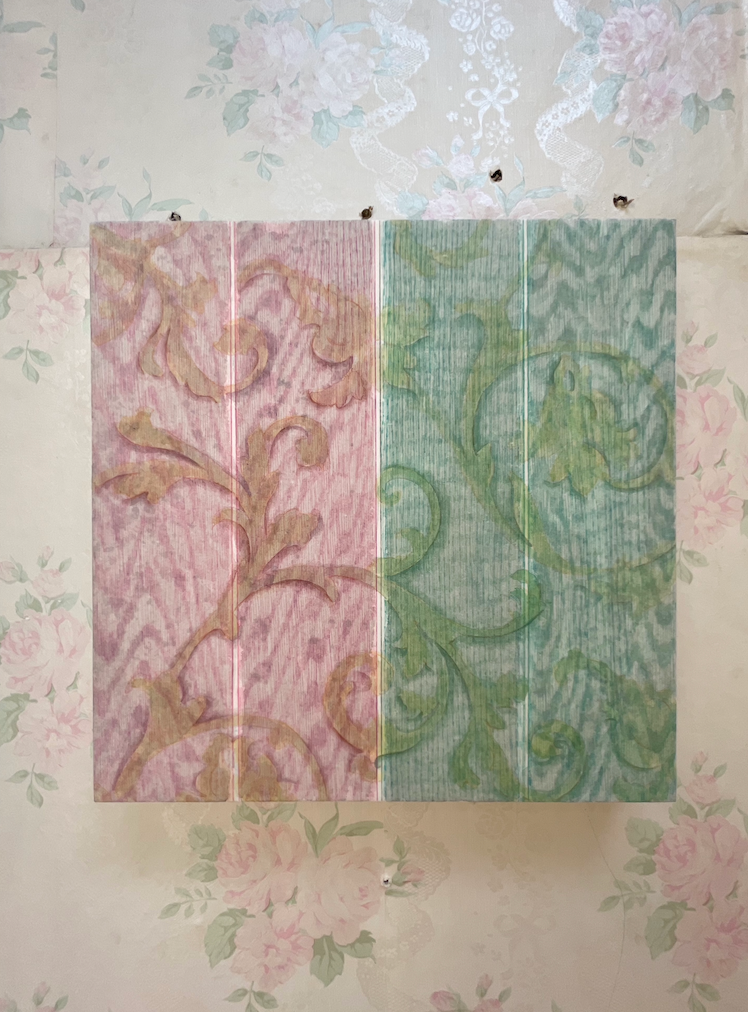
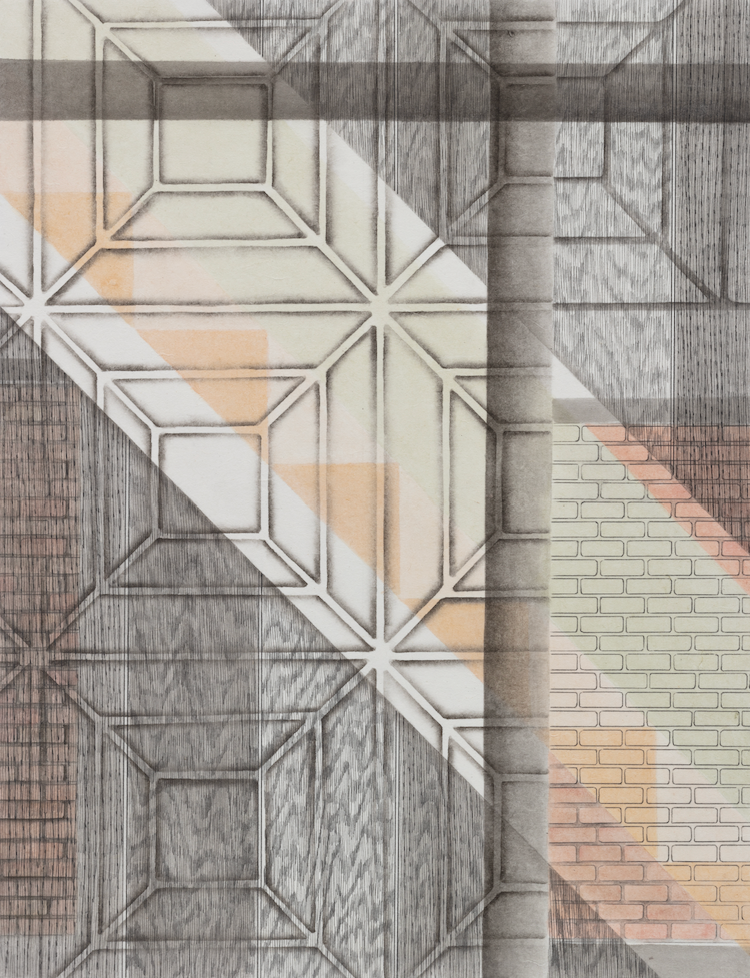
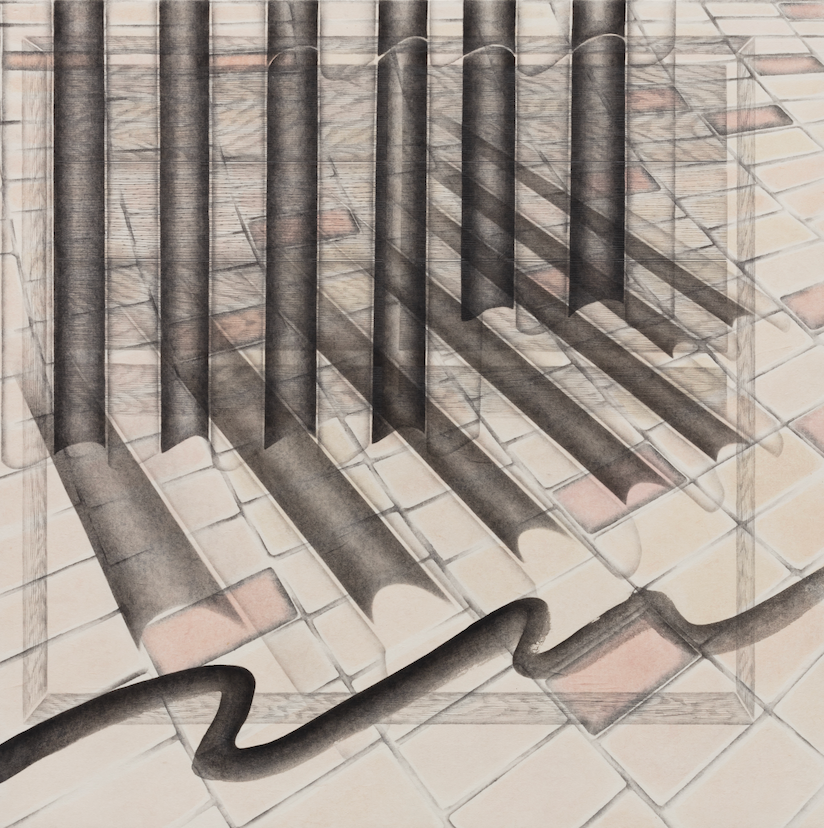
Curve, 2021
장지에 샤프펜슬, 먹, 채색_72.7x53cm
Mechanical pencil, Ink, Color on Jangji_72.7×53cm
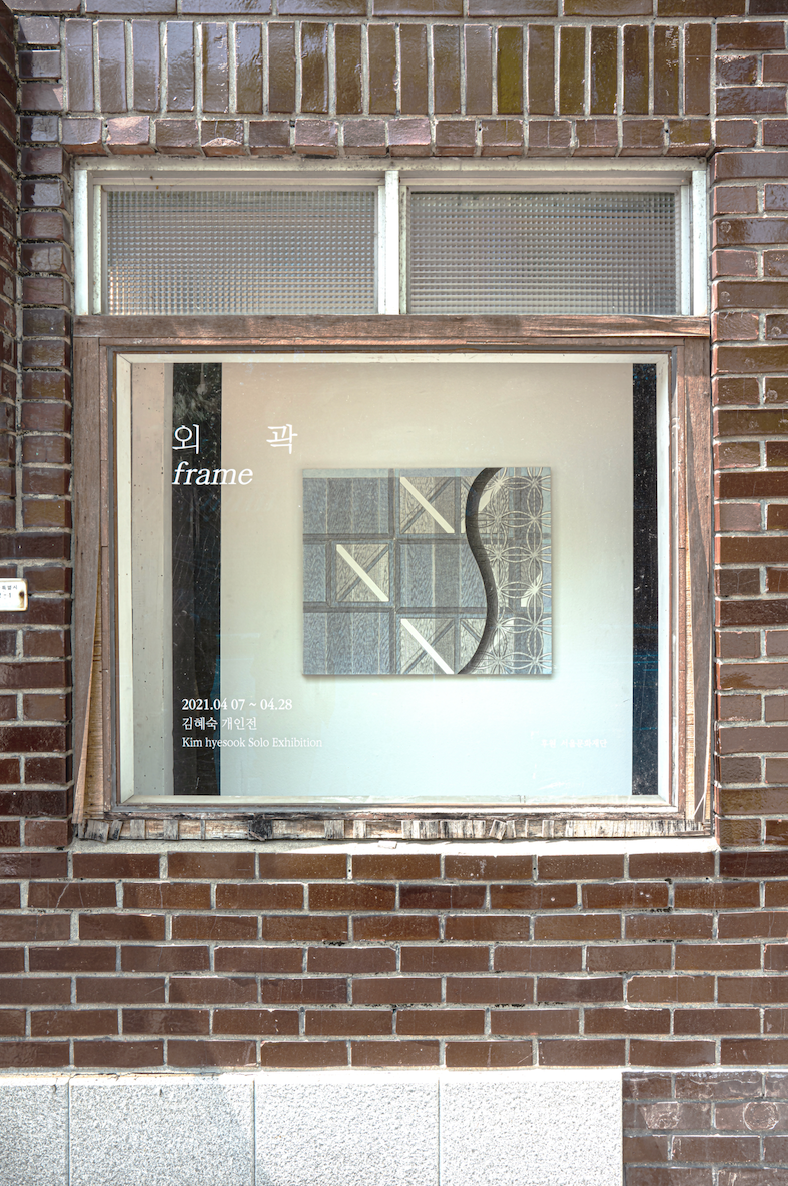
외곽
frame
2021
기간_2021.04.07_04.28
장소_아트스페이스 보안1_통의동 보안여관
Solo Exhibition
후원_서울시, 서울문화재단
Period_April.14~April.13. 2022
Venue_ARTSPACE BOAN 1_Tonguidong BoanYeogwan(inn)
sponsored by Seoul Metropolitan Government, Seoul Foundation for Arts and Culture
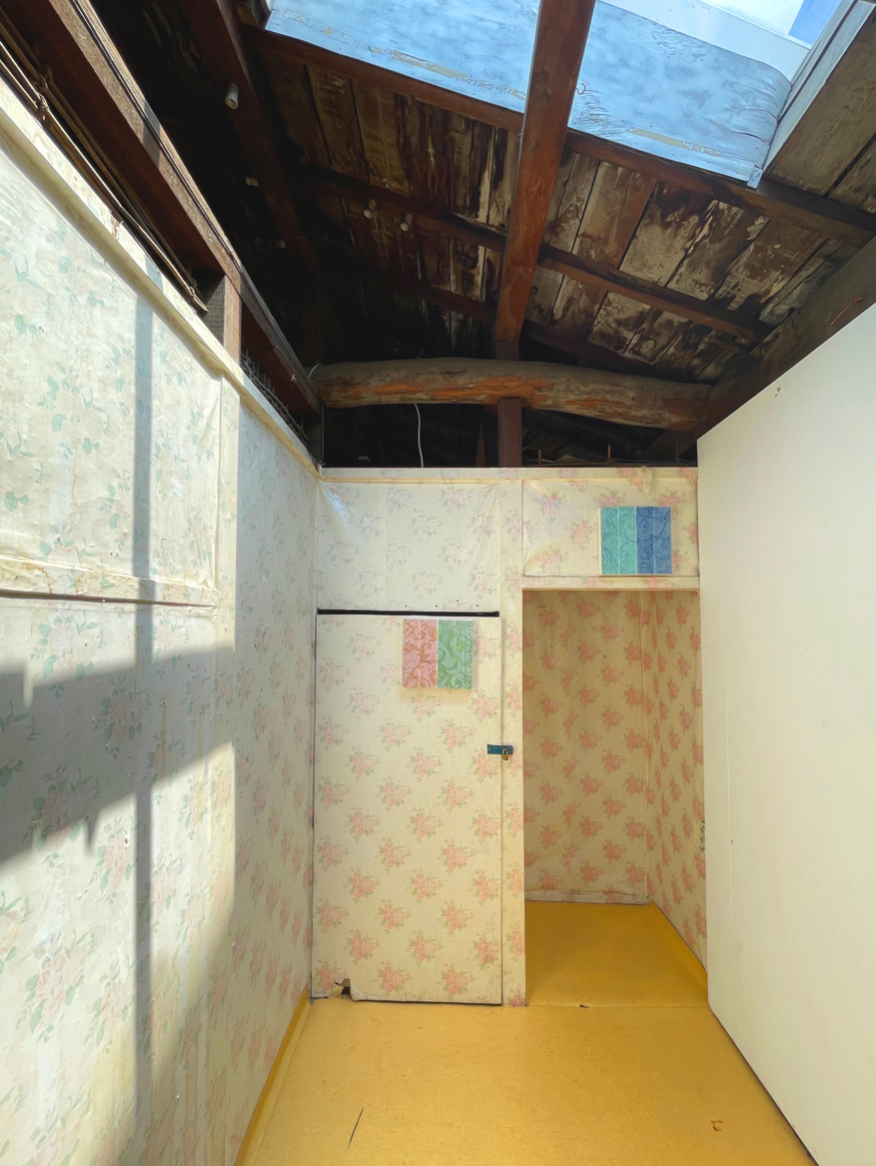
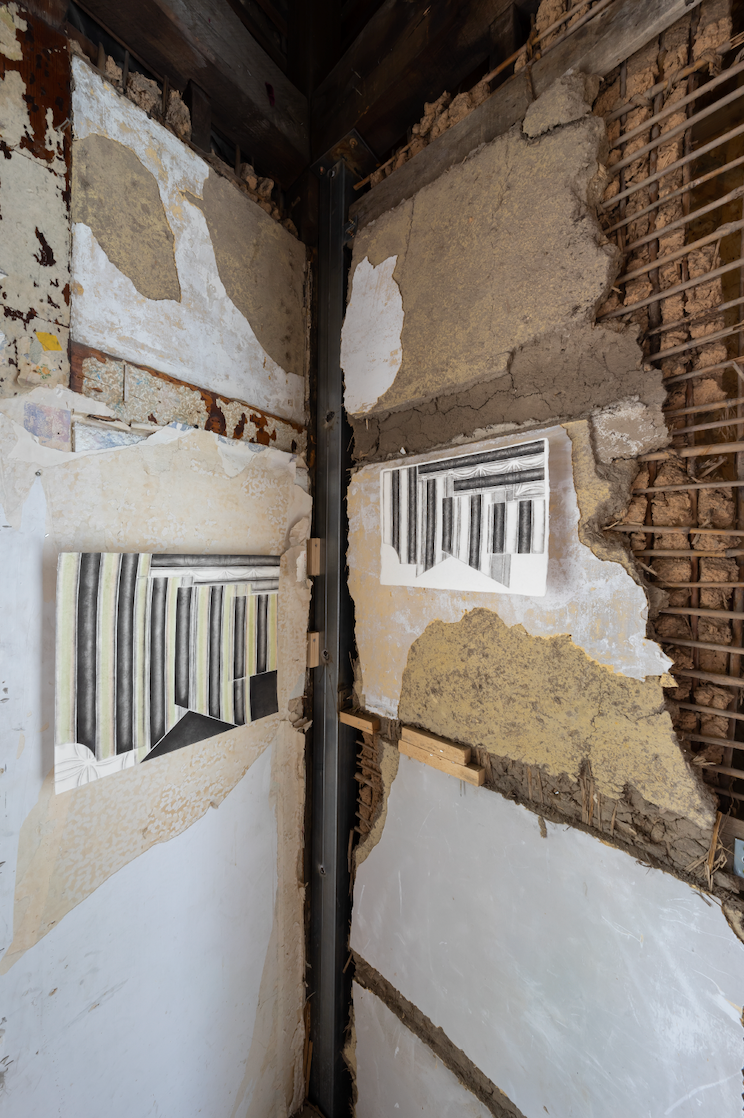
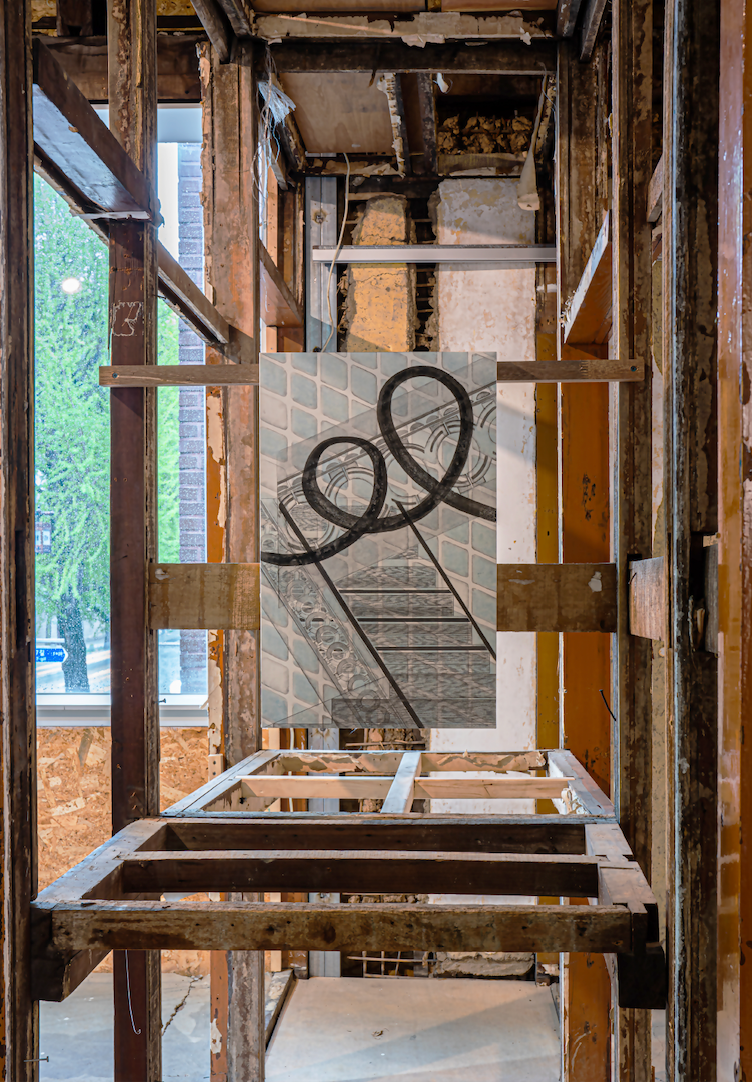
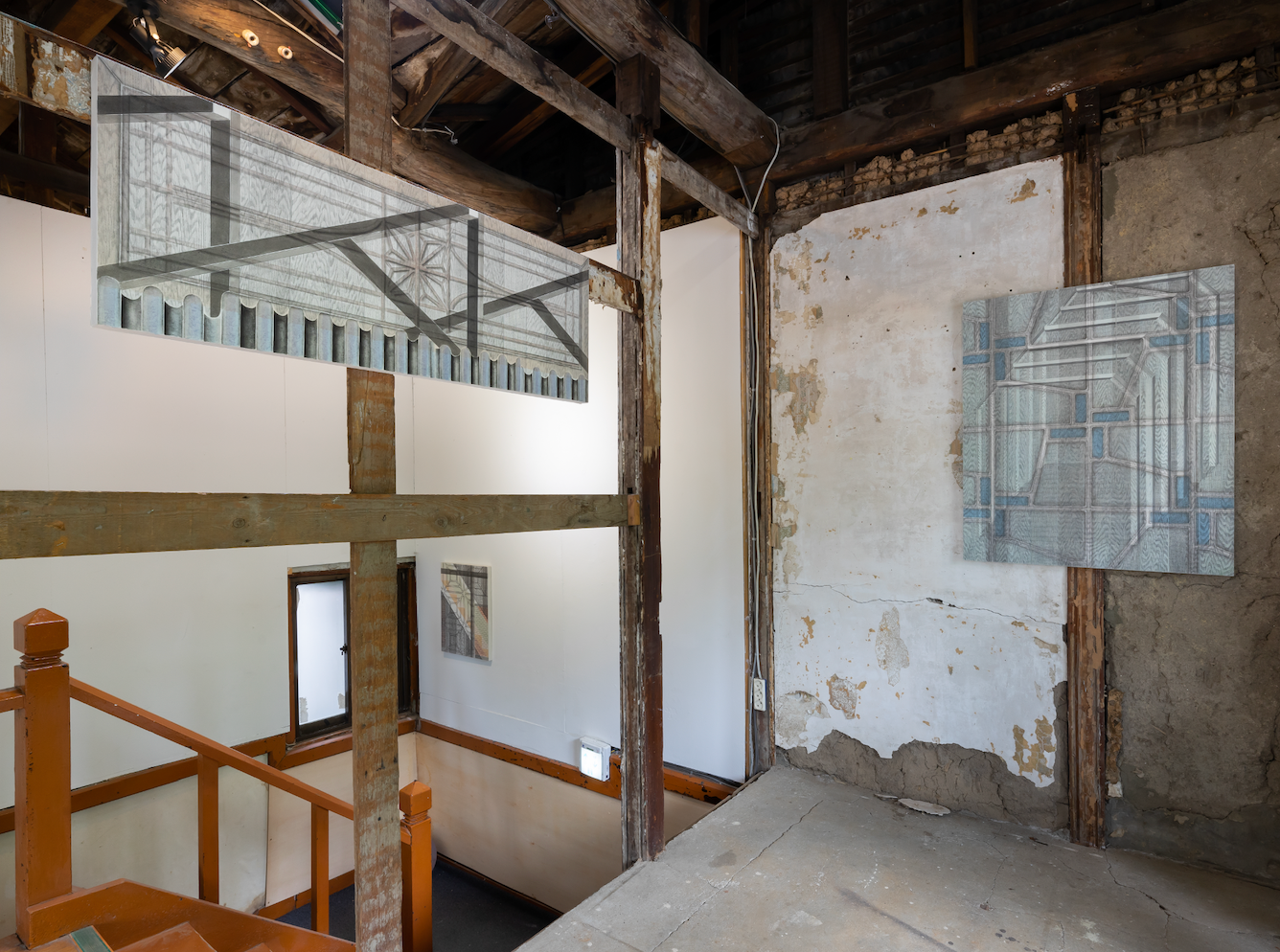
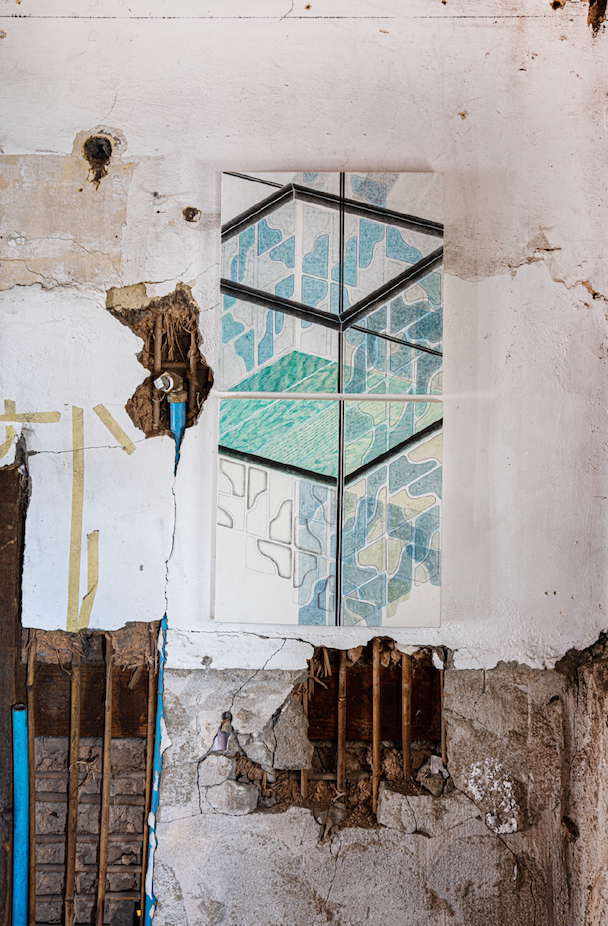

외곽
김혜숙
공간에 쌓인 시간의 단서들을 모아 공간을 해체, 재구성하여 보여주는 작업을 진행하고 있으며 2017 군산, 2018 청주에 이어 이번 전시는 현재 살고있고 동두천 일대의 공간들을 다룬다. 항상 내가 마주한 낯선 공간, 서있는 곳을 빨리 파악하려는 경향이 있는데 그래야 그 공간에서 안정을 취할 수 있기 때문이다. 왜 시작이 근대였나라고 질문한다. 현재에 내가 보고있는 공간의 층위들의 시작은 어디서부터였을까란 궁금증이 있었고 도시공간의 시작은 근대기라는 방향이 있었다. 하지만 시간에 대한 의미의 모호함과 확장가능성을 두고 다른 지점을 바라보게 되었다. 이번 전시 <외곽>은 기존의 작업을 이어오며 스스로가 느낀 한계에 대한 고민을 풀어가며 매체의 물질성, 사용하는 재료, 작가의 움직임이 담기는 화면의 공간, 그것을 나누는 선면의 다양한 활용에 대해 생각해 본 전시이다.
선과 색이 만나 이루는 면의 배치는 건물을 둘러싼 외벽, 발코니, 창문, 지붕 등의 구조에서 가져왔다. 선택되어진 공간은 그곳을 이루는 선들의 움직임을 따라 시선이 세로의 직선, 가로의 직선, 대각선, 곡선, 원의 둥근 선 등 공간이 지닌 틀에 관한 기준선이 존재했다. 이 기준선은 바라본 작가의 시선이 되어 화면의 변주를 주는 시작점이 되어준다. 오래된 건물에 겹겹이 쌓인 벽돌위에 타일, 타일 위에 페인트라는 층위들은 시간의 누적을 보여준다 생각했고, 그것을 화면으로 가져오며 그곳이 지닌 선과 면의 기준선을 통해 화면을 분할하고 색의 배치를 고민해보았다. 과거의 작업들은 무엇을 어떻게 하면 그림이라는 것을 시작할 수 있을까에 집중한 그림들이라면 최근에는 어떻게 그려내야 할지에 더 집중한다.
사용하고 있는 선(Line)의 성격이 기록적이며 얇고 여리지만 굵기의 변화가 적어 명확한 반면, 지워지는 특성은 소심한 나의 성격에 굳어져 버릴 수 있는 생각의 얇은 틈을 만들고 변화를 받아들이는 수단이 되어준다. 수많은 섬유질의 엉킴 사이사이로 스며드는 날카로운 샤프의 선과 그 틈의 박힌 흑연의 미세한 높낮이는 그 안을 거닐 때 벽을 쓸어내리던 손의 질감을 보는 이로 하여금 눈의 촉각치로 전환시켜주는 방식이 되어 준다고 생각한다. <외곽>에서는 기존에 사용하던 가느다란 선에 다양한 굵기의 선을 만들어 화면에서 주는 변화를 관찰해보았다. 그것은 마치 공간에서 시간이 주는 변화를 시각적 운율로 드러낸다 생각했고 그렇게 지금의 화면이 만들어졌다.
다양한 옅은 색(Color)의 물감을 화판위에 채색하고 말리기를 반복하여 색을 조합하는 방식을 통해 또 다른 공간을 화면 안에 포개어 여러 차원이 드러나도록 하는 것은 과거와 현재가 공존하는 공간을 표현하고자하는 의지였던 것 같다. 어떤 시간을 딱 잘라 구분하는 것 자체가 모순이 아닐까라는 생각은 이러한 방식의 변화로 드러났다. 이런 색의 바탕이 되는 장지는 모든 것을 품어주는 재료이다. 안료가 위로 쌓이는 서양 재료와 다른 스밈의 성격은 그리는 행위자로 하여금 안정감을 주며 머무를 수 있는 자리를 내어주는 공간의 성격과 닮아 있다고 생각한다. 그래서 나는 오래되고 낡은 공간을 좋아하지만 그것을 그대로 그리기보다는 그것이 태어났을 처음을 기억해주며 먼지를 닦아내고 묵은 때를 벗겨낸다. 그리고 그곳이 지닌 색들을 찾아내어 회면에 배치했다.
나를 통해 이미지들은 선택과 소외를 받는데 나는 그것을 기억으로 기억한다. 결국 편집된 기억 안에서 소외된 이미지들로 경계를 짓는 것은 스스로가 아니었나 생각하며 최근에는 이러한 단정짓기를 통해 형성된 의미를 경계하며 느슨하게 보여주는 공간의 표현기법을 고민하고 있다. 그런 점에서 투명하거나 투과되는 방식의 공간을 덧입히는 방식으로 변화를 겪게 되었고, 이렇게 공간의 안과 밖을 허물어 겹치고 연결짓는 행위는, 지나갔다고 생각했지만 그 곳에 여전히 남겨진 시간을, 무엇으로 어떻게 구체화시킬 것인가에 대한 고민의 과정을 되짚어가고 있다고 생각한다.
frame
By Kim Hyesook
I have consistently worked on collecting temporal clues found in a space, deconstructing and also reconstructing them. This exhibition addresses spaces in the Dongducheon area where I am living now in the wake of my 2017 (Peripheral Vision) solo show in Gunsan and 2018 (Knock, Knock) solo show in CheongjuThis exhibition (Frame) at Artspace BOAN1942 in Seoul touches on media corporeality, used materials, a scene's space capturing the artist's movement, and diversified use of lines and planes dividing such space, disclosing my concerns about the limitations I felt when previously doing my work.
My arrangements of planes consisting of lines and colors were inspired by the structures of outer walls, balconieswindowsand roofs. In a chosen space there is a baseline defining a frame, such as length's straight line, width's straight line, the diagonal line, and a circle's curved line. This baseline is a starting point for variations in a frame. I thought the layers of tiles on bricks and paints on tiles demonstrate the accumulation of time and considered how to divide a scene and deploy colors through line and plane. While my previous work focused primarily on how to begin painting, my recent work concentrates on how to paint.
The lines I use are thin and subtle yet clear because they have little change in thickness. On the other hand, they can be erased easily to generate tiny cracks in my fixed notions and to embrace change. In (Frame), lines of different thicknesses along with thin lines I have already used bring about change in my scenes. This reveals changes by time as visual rhythms. My current scenes were produced in this way.
Different dimensions are revealed by overlapping spaces in a way that repeats to apply a diversity of light colors and dry them. This probably resulted from my will to express a space where the past and present coexist. My idea that it may be contradictory to distinguish a span of time definitely is revealed by change in this way. Thick Korean paper used for the ground of painting is a material embracing allI think unlike any Western material on which pigments are piled up, its character of permeating bears a resemblance to that of a space that makes its practitioner feel stable and offers a place to stay. Even though I like the space and worn, I wipe the dust off and scrub dirt off this old space, rather than depicting it as it is. And then, I look for colors that old place retains and bring them to my scenes. It's a way to remember the first time a space was born.
Images are selected and alienated by me, which I remember. Considering it was me who drew a boundary with marginalized images in my edited memory, am wary of the meanings formed by such a hasty conclusion and concerned about how to express such a spaceIn this sense, my work has undergone changes in the way of overlapping spaces and carried out an action of making the inside and outside of a space overlapped and connected. So now, I think my work has going on through a process of figuring out how to concretize the time left behind by a space.
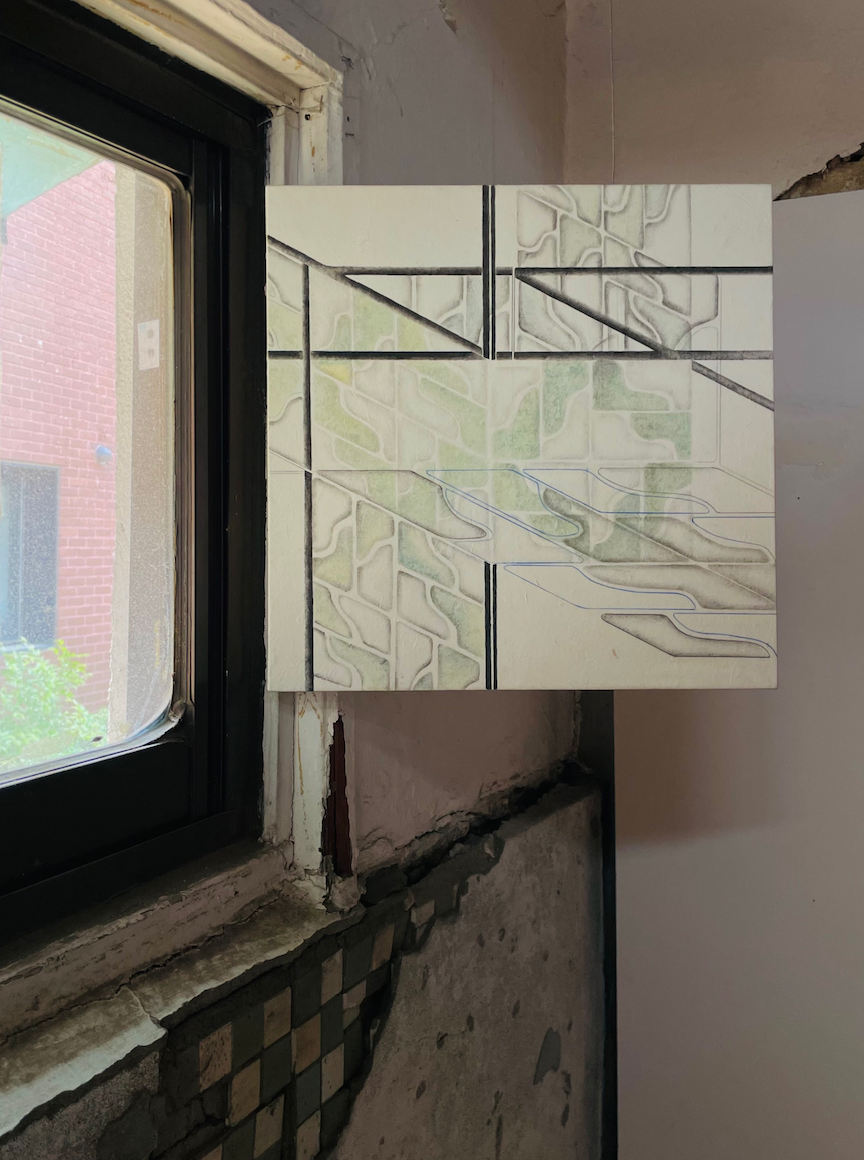
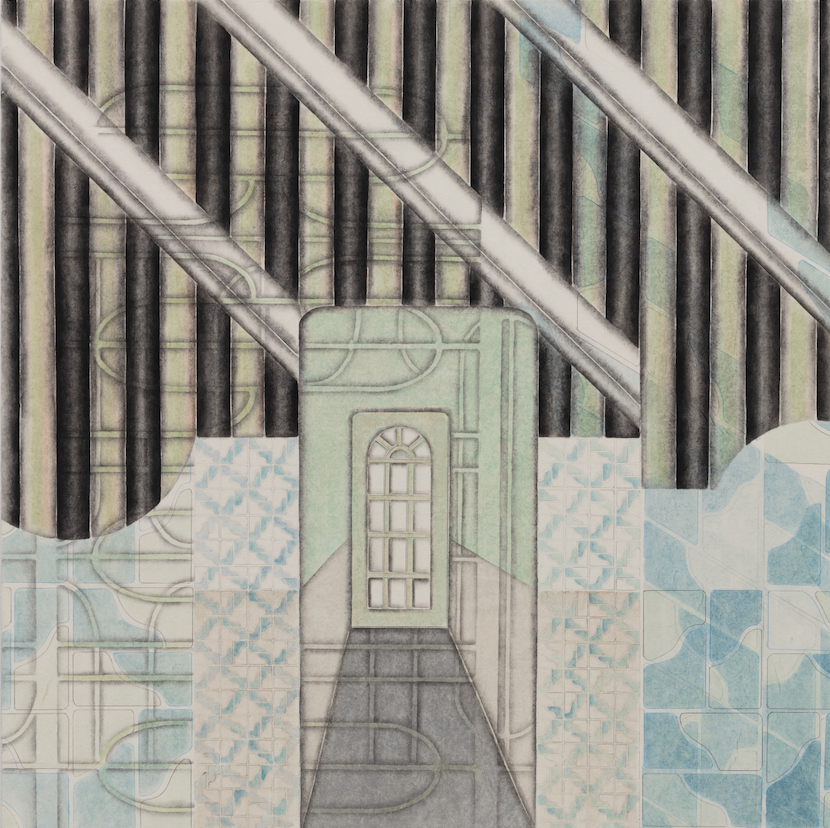
Curve, 2021
장지에 샤프펜슬, 먹, 채색_60x60cm
Mechanical pencil, Ink, Color on Jangji_60×60cm
도시의 피부를 그리는 방법
박지형 (독립 큐레이터)
겹쳐지는 것들에 대해 말해보자. 김혜숙에게 겹 구조는 작품 제작 방식의 핵심이자 개념적인 근거이다. 작가의 손이 꼼꼼히 훑어간 자리에는 어김없이 질료의 쌓임이 남는데, 이는 그가 기억을 되새기며 형상을 만들어내는 데 적지 않은 시간을 종이 위에서 보냈음을 증명한다. 여러 시점의 이동 역시 한 화면 안에 중첩되어 그가 도시를 바라보는 입체적인 태도를 함축적으로 나타낸다. 말하자면 그의 작업 전반에서 도드라지는 질감은 얇은 종이의 결 사이로 스며든 물감의 여러 농담과 샤프의 얇은 흑연이 밟고 지나간 흔적의 레이어다. 이 층위들은 무엇의 지표인가?
포개어진 형태들은 작가가 현실의 공간적 맥락을 시간 축의 영역으로 변환하는 실험 속에서 압축된 기호이다. 도시의 여러 장면들을 관찰하여 그린 그림이므로, 작품들은 특정한 시기의 풍경을 대변한다고도 할 수 있겠다. 연이어 드는 생각은 과연 그의 작업 세계를 풍경화라는 독립된 장르로 명명할 수 있을까 하는 점이다. 작가의 시선이 닿은 중성적인 장소들은 곧 의미를 갖는 풍경의 영역 안으로 들어온다. 특히 자연이 아닌 인공적인 사물이나 건축물 등에 집중하는 그는 누군가의 시선을 비켜나갔던 주변부의 시간을 회화적 프레임 안으로 소급시킨다. 그러나 도시로부터 추출된 크고 작은 입자들은 실재에 관한 총체적인 기록에 동원되는 대신 상상적 세계를 구현하는 근거가 된다. 리드미컬한 선의 점진적 이행, 건축 자재의 질감과 대비되는 색의 명암, 대담한 프레임 분할 등 부단히 그 역할을 달리하는 도시의 역동적인 면면들은 구체적 장소성과 역사성을 상실하고 오롯한 시각적 단위로서 새롭게 위치한다. 따라서 그의 그림을 리얼리티를 담는 풍경화로 속단하기에는 그 이상의 자의적이고 함축적인 작동 원리가 내재하고 있음을 인지하게 된다.
그가 처음부터 기하학적 추상에 가까운 그림을 그렸던 것은 아니다. 작가가 2010년대 중반까지 보여준 작업들은 이와 사뭇 다르다. 작가가 군산에서 머물며 관찰한 것들을 엮어낸 <장미동>(2015-6) 연작의 경우, 한 화면에 제법 구체적인 골조가 들어서며 건축적 구성물들 간의 비현실적인 결합과 확장이 강조되어 있다. 특히 평면도를 여러 시점에서 관찰하고 부감하듯 이리저리 재조합한 느낌을 주는데, 하나의 연극적 장면을 연출하고자 하는 작가의 의지를 반영하는 듯하다. 따라서 완성된 작품들은 가상의 장(scene)안에서 가능할 법한 신체적 경험을 상상하게끔 유도한다.
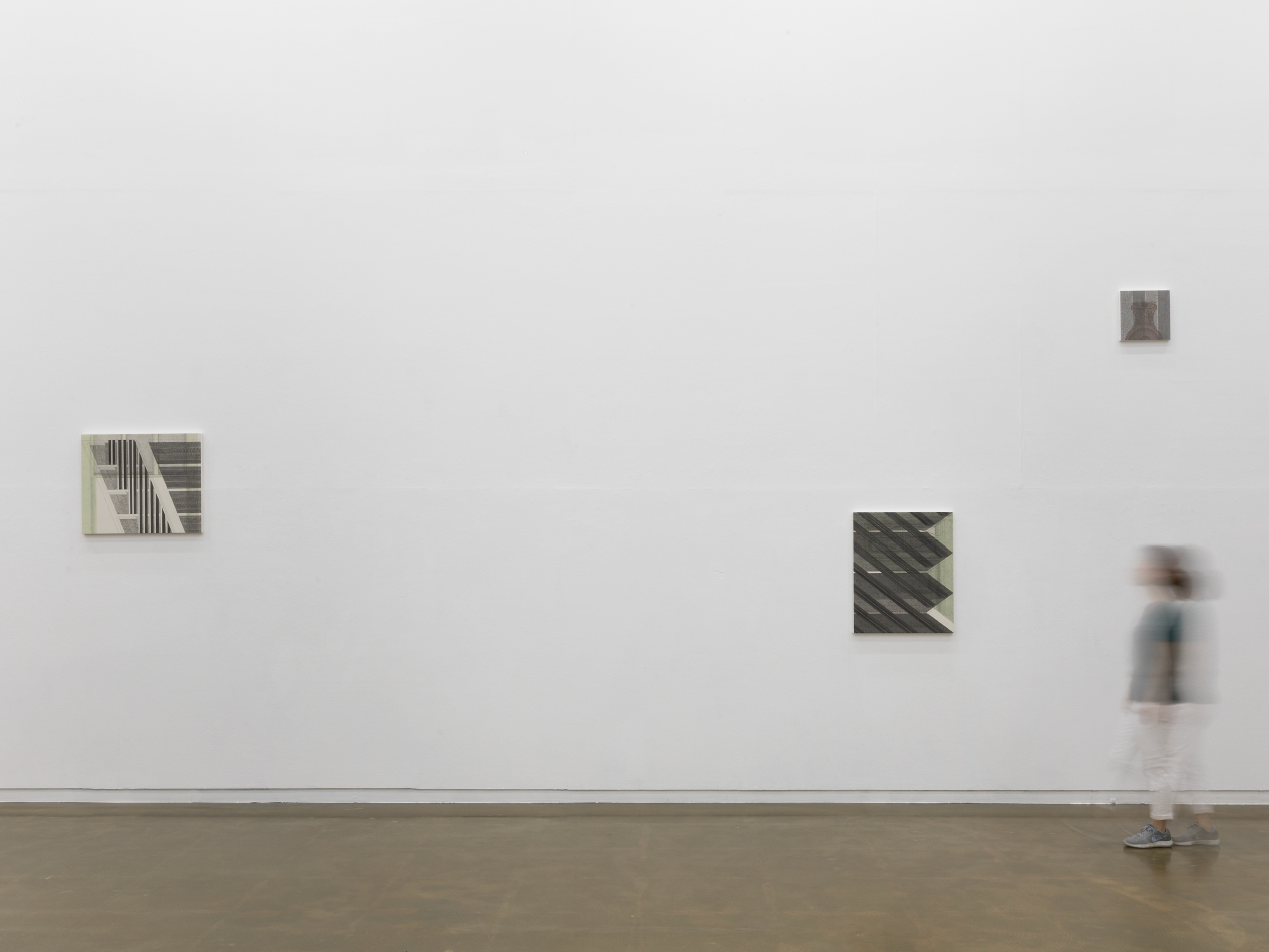
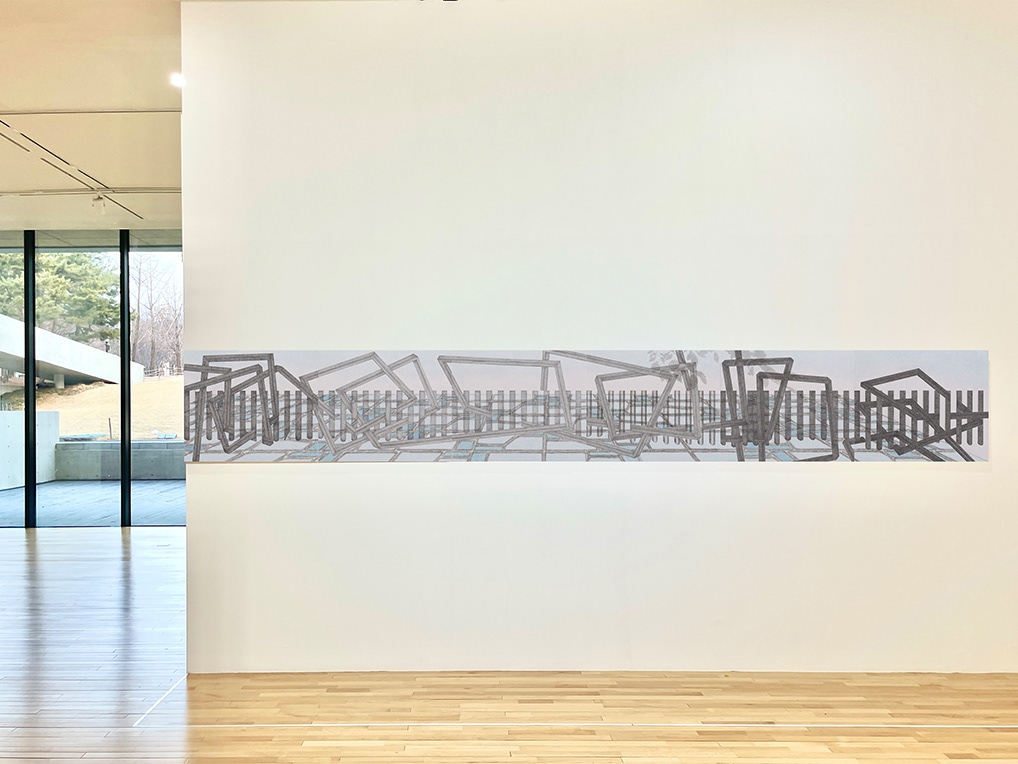
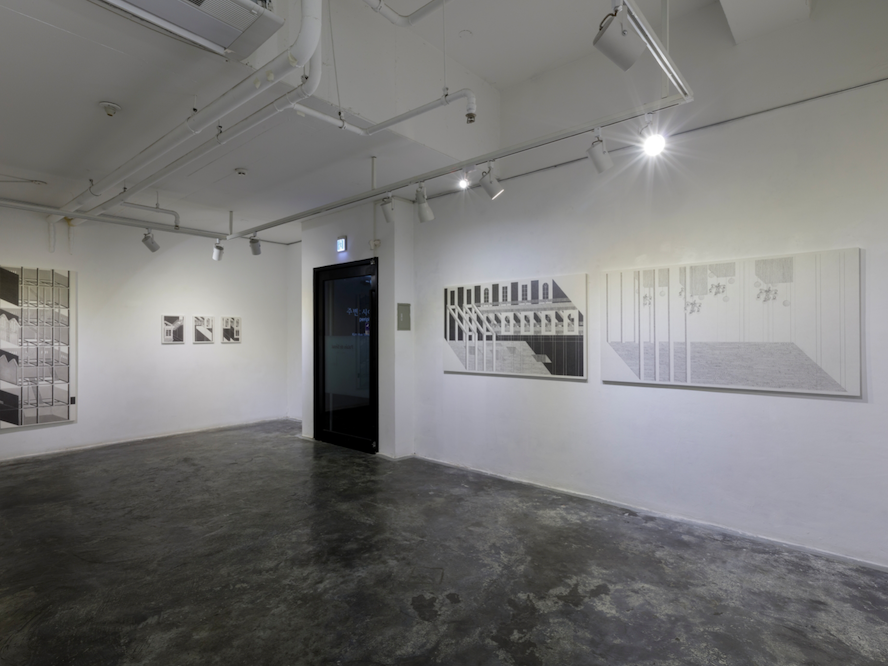
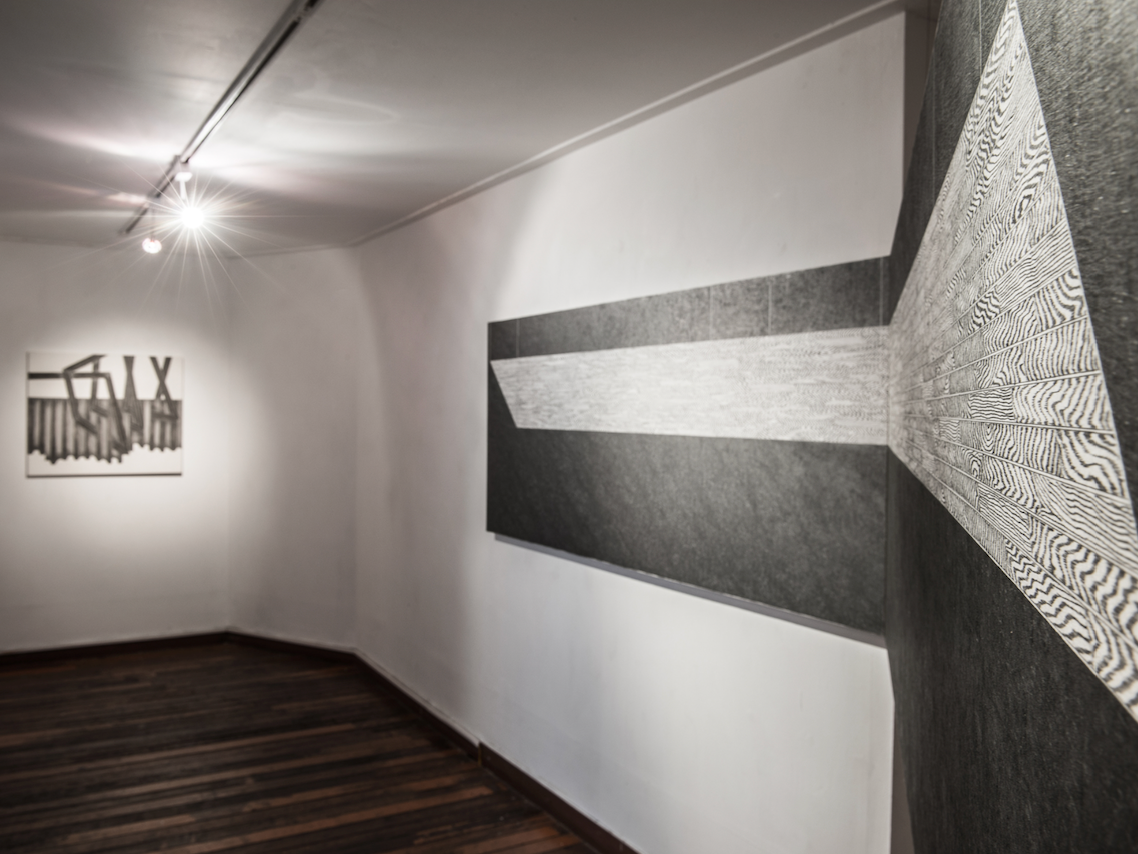
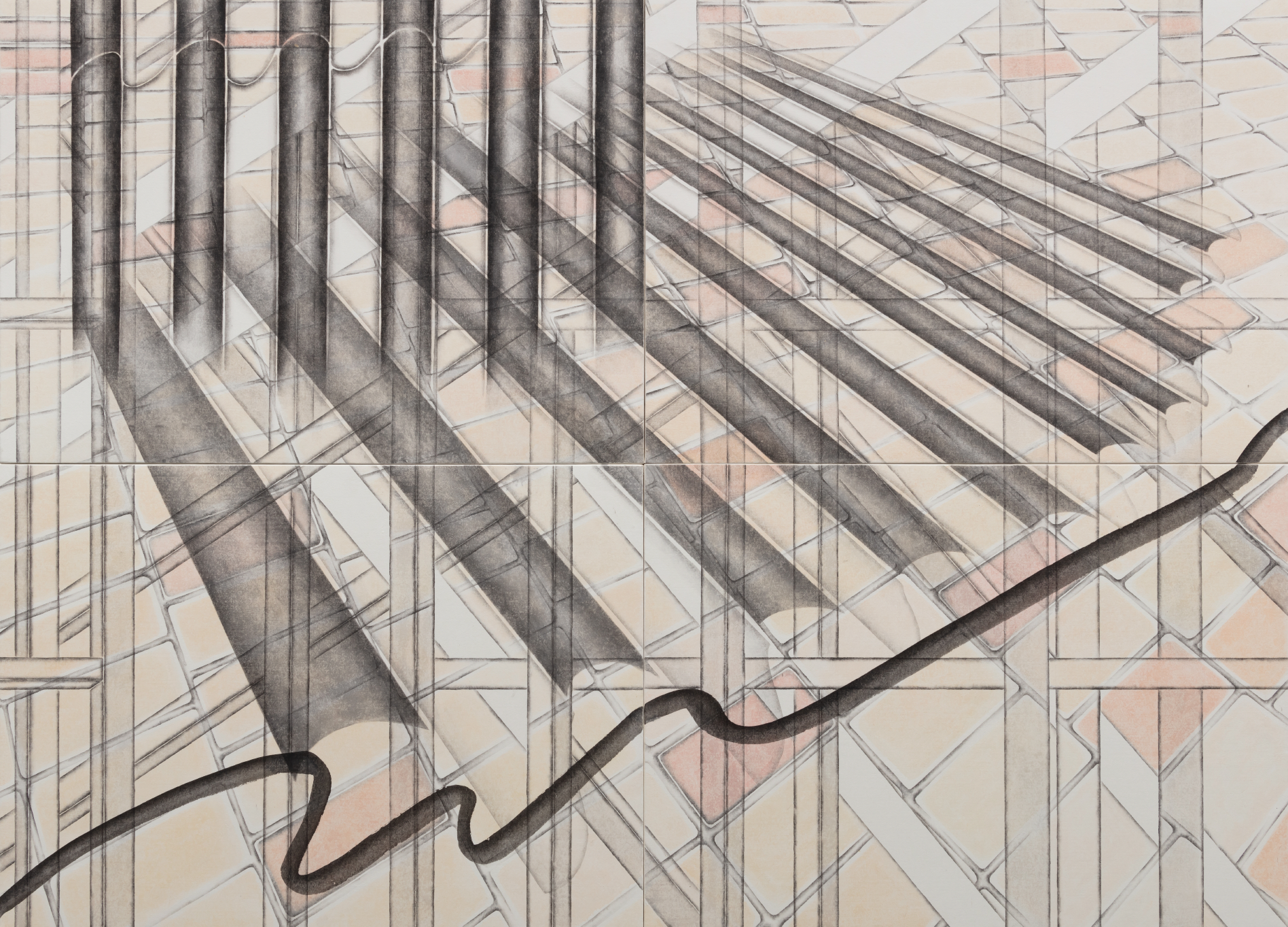
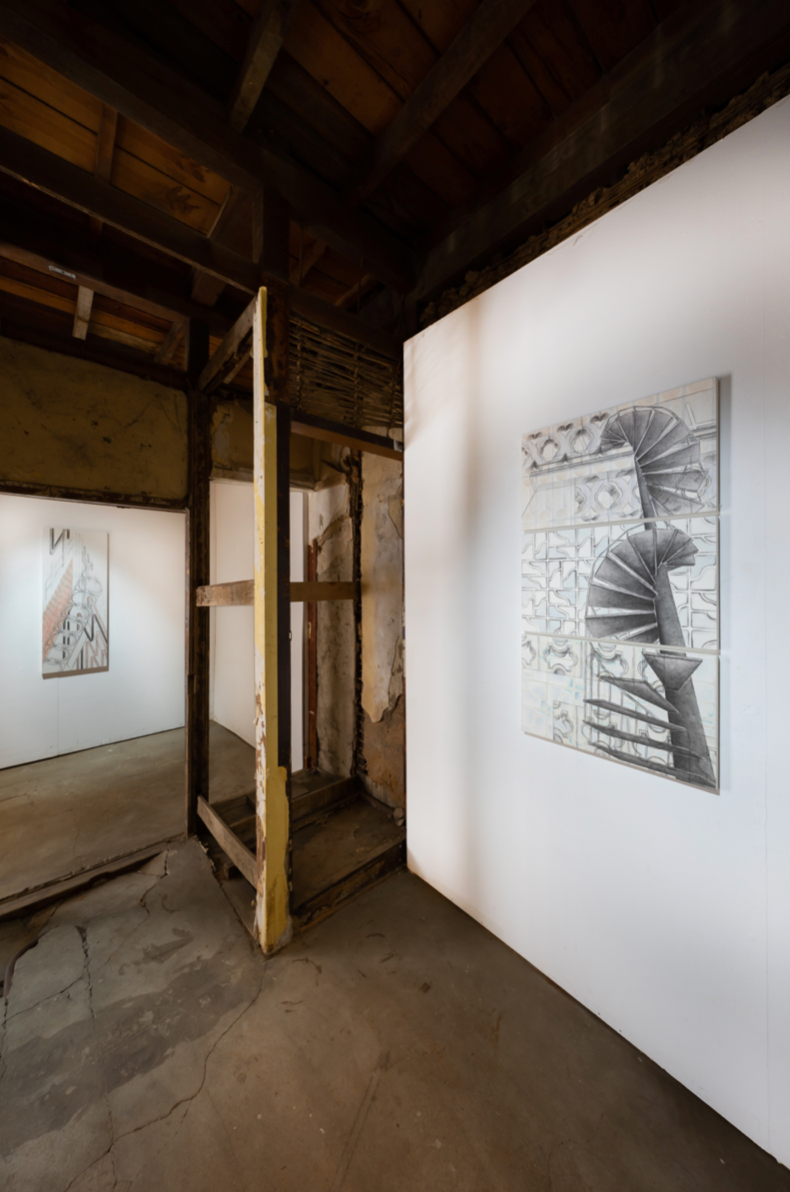
이와는 달리 전시 《외곽》(2021)에서 선보인 작업들은 인공물로부터 추출한 조형적 단서들을 보다 자유롭게 배치하고 이를 임의의 규칙에 따라 재전유하고 있다. 따라서 어떤 구조물은 아주 크게 확대되고 또 다른 부분은 작게 축소되며 추상적 패턴을 형성한다. 나선형 계단의 굴곡, 타일 바닥의 그리드, 창문의 형태와 나무 바닥의 질감은 화면 전면부에 교차되며 나타나므로, 관객은 작가가 제시하는 재현 앞에서 3차원적 감각을 상상하기보다는 일상적 단상들이 직조하는 시각적 리듬을 읽어내는 데 집중하게 된다. <Mosaic Tile>(2019)이나 <Curve>(2021) 연작의 경우 세밀하게 배치된 기하학적 형상의 조합이 만들어내는 균형과 긴장, 속도감 등이 도드라지는 것을 볼 수 있다. 이러한 형식 상의 변화는 실제 작가의 관찰 시점과 감정적 상태, 또 도시를 체화하는 방식이 점진적으로 이동했다는 것을 이야기한다. 즉 이는 작가가 때로는 원거리에서, 또 때로는 근거리에서 현실에 몰두하며 공간과 신체 사이의 거리를 적극적으로 조율하기를 멈추지 않는 자세가 반영된 결과이다.
이와는 달리 전시 《외곽》(2021)에서 선보인 작업들은 인공물로부터 추출한 조형적 단서들을 보다 자유롭게 배치하고 이를 임의의 규칙에 따라 재전유하고 있다. 따라서 어떤 구조물은 아주 크게 확대되고 또 다른 부분은 작게 축소되며 추상적 패턴을 형성한다. 나선형 계단의 굴곡, 타일 바닥의 그리드, 창문의 형태와 나무 바닥의 질감은 화면 전면부에 교차되며 나타나므로, 관객은 작가가 제시하는 재현 앞에서 3차원적 감각을 상상하기보다는 일상적 단상들이 직조하는 시각적 리듬을 읽어내는 데 집중하게 된다. <Mosaic Tile>(2019)이나 <Curve>(2021) 연작의 경우 세밀하게 배치된 기하학적 형상의 조합이 만들어내는 균형과 긴장, 속도감 등이 도드라지는 것을 볼 수 있다. 이러한 형식 상의 변화는 실제 작가의 관찰 시점과 감정적 상태, 또 도시를 체화하는 방식이 점진적으로 이동했다는 것을 이야기한다. 즉 이는 작가가 때로는 원거리에서, 또 때로는 근거리에서 현실에 몰두하며 공간과 신체 사이의 거리를 적극적으로 조율하기를 멈추지 않는 자세가 반영된 결과이다.
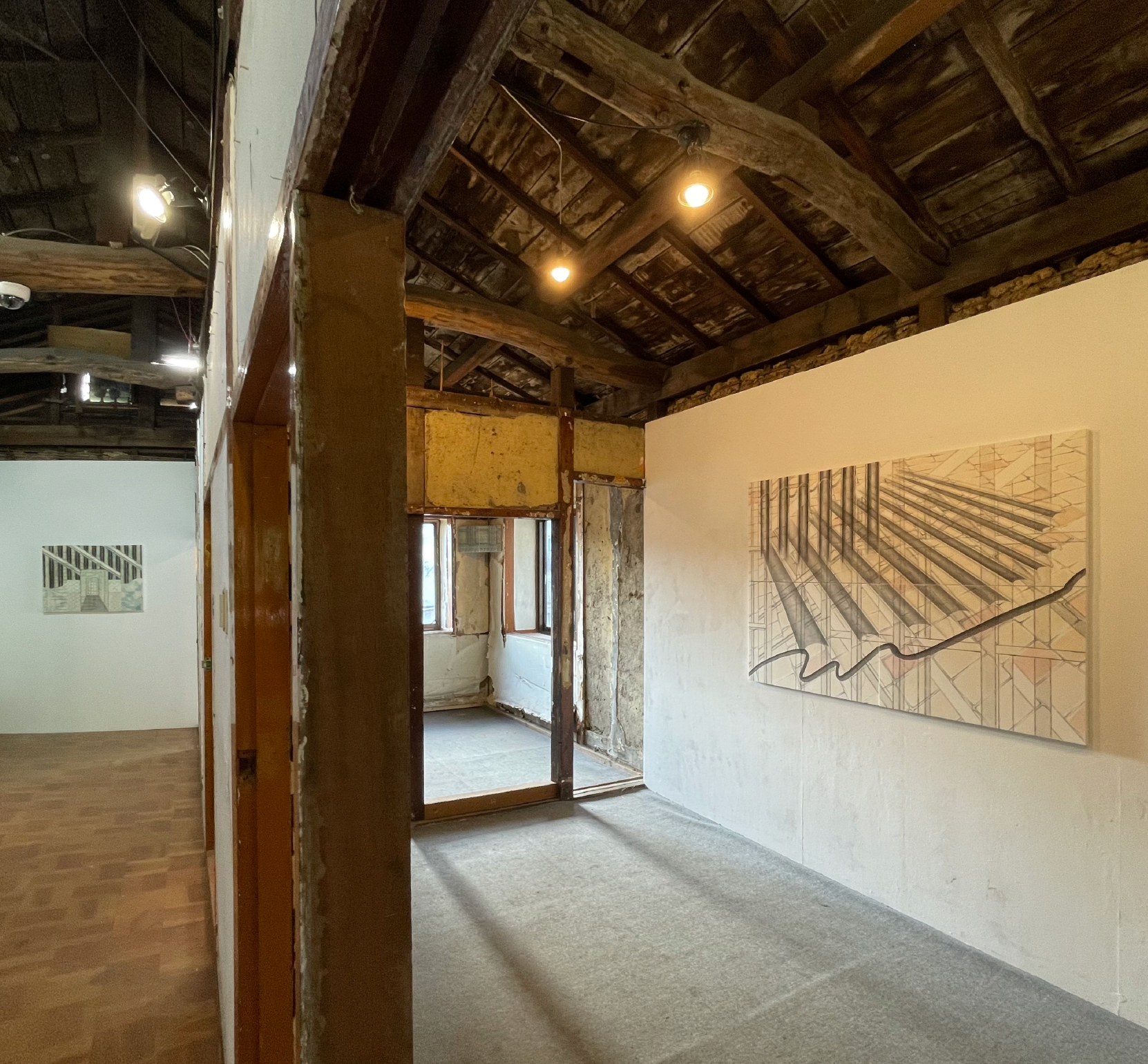
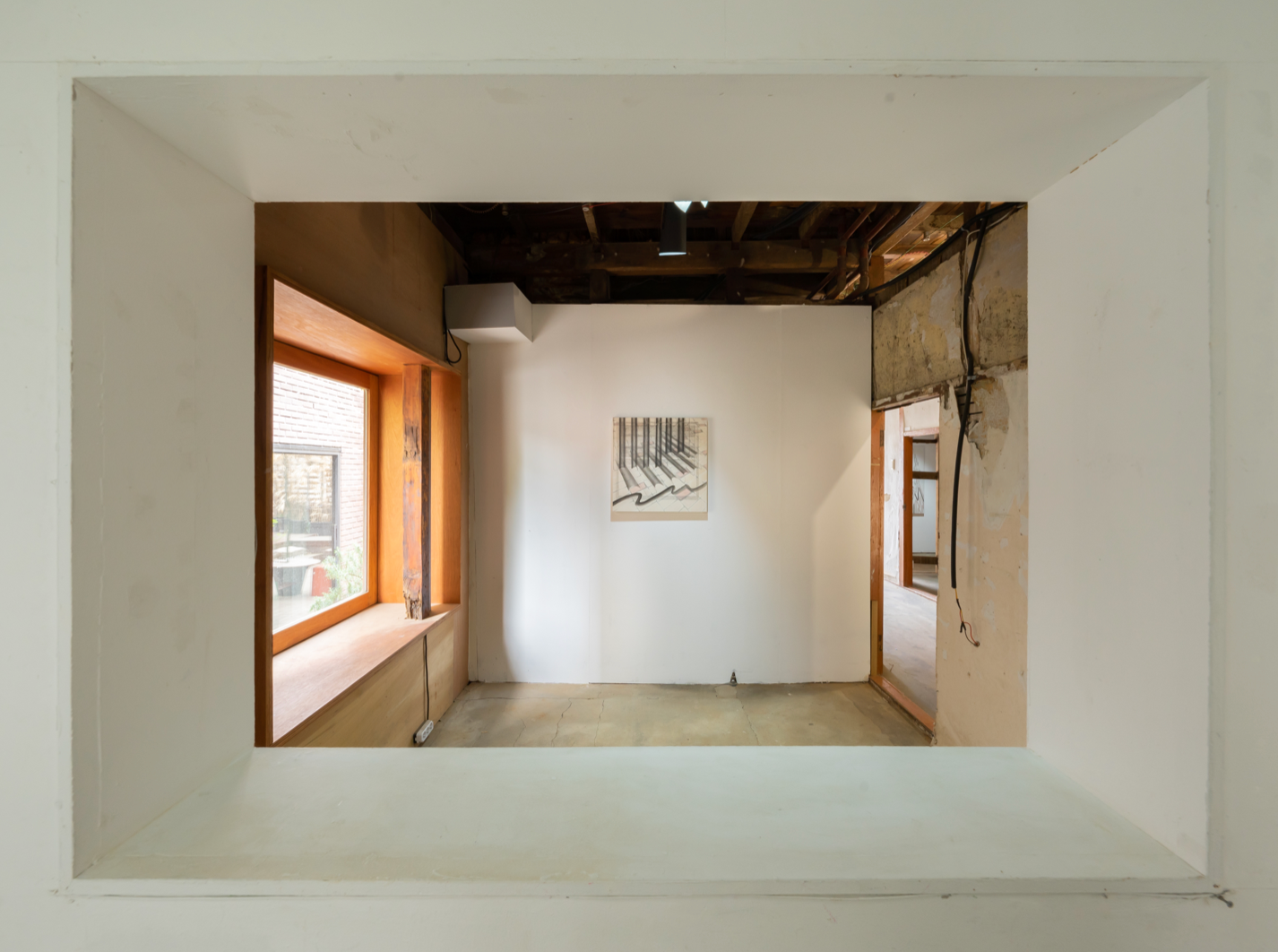
간과해서 안될 또 다른 지점은 작품을 보안여관이라는 상징적인 의미의 영역과 어떻게 연결 지을까 하는 것이다. 보안여관은 60여 년이 넘는 시간 동안 서울이라는 한 도시의 변화를 묵묵히 지켜보며 서있었던 목격자이자 수많은 사람들의 기억과 연결된 매개의 플랫폼이다. 이제는 골조만 남은 건물의 방 구석구석에는 여전히 과거의 씨실이 짜여 남아있다. 그리고 이곳에 작가가 만든 퍼즐과도 같은 이미지가 날실처럼 엇갈려 올라선다. 역사적 특수성을 띤 무대에서의 전시는 언제나 양가적인 변수로 작동한다. 한편으로 이러한 시도는 작품의 개별적인 의미가 축소되거나 장소의 에너지에 작가의 의도가 함몰될 위험을 안는다. 그러므로 전시장의 특수성과 작품의 개념 간에 어떻게 유기적 관계를 이끌어 낼 것인지가 충분히 고려되어야 한다.
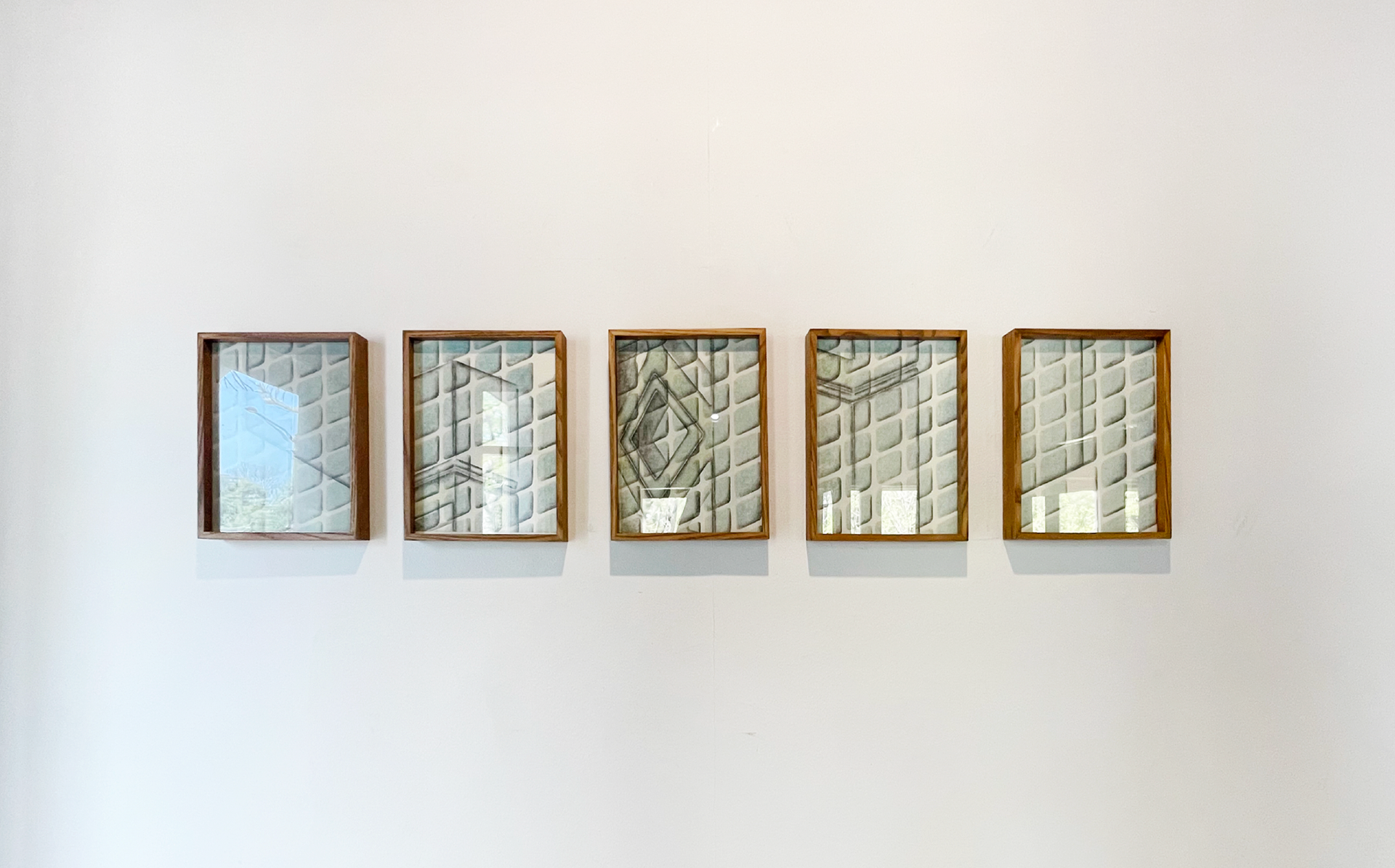
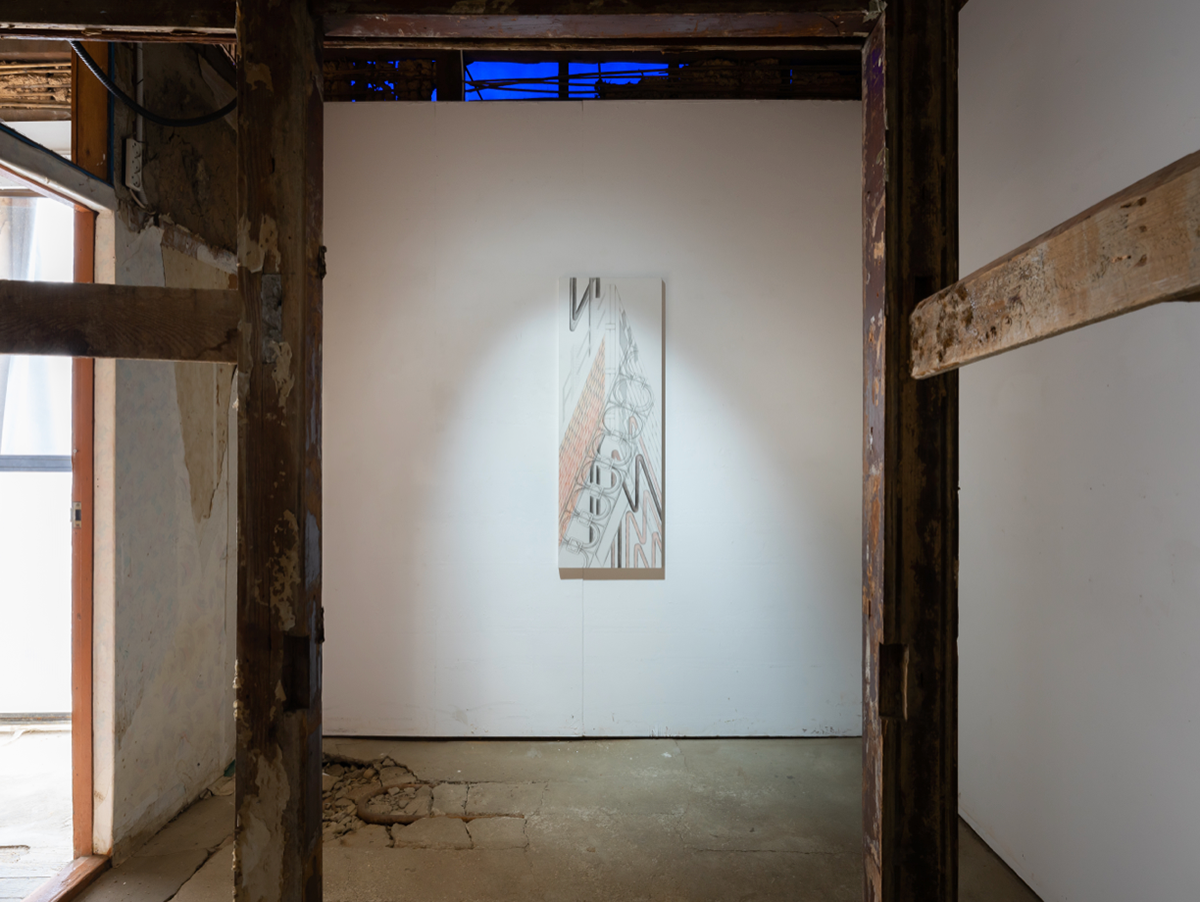
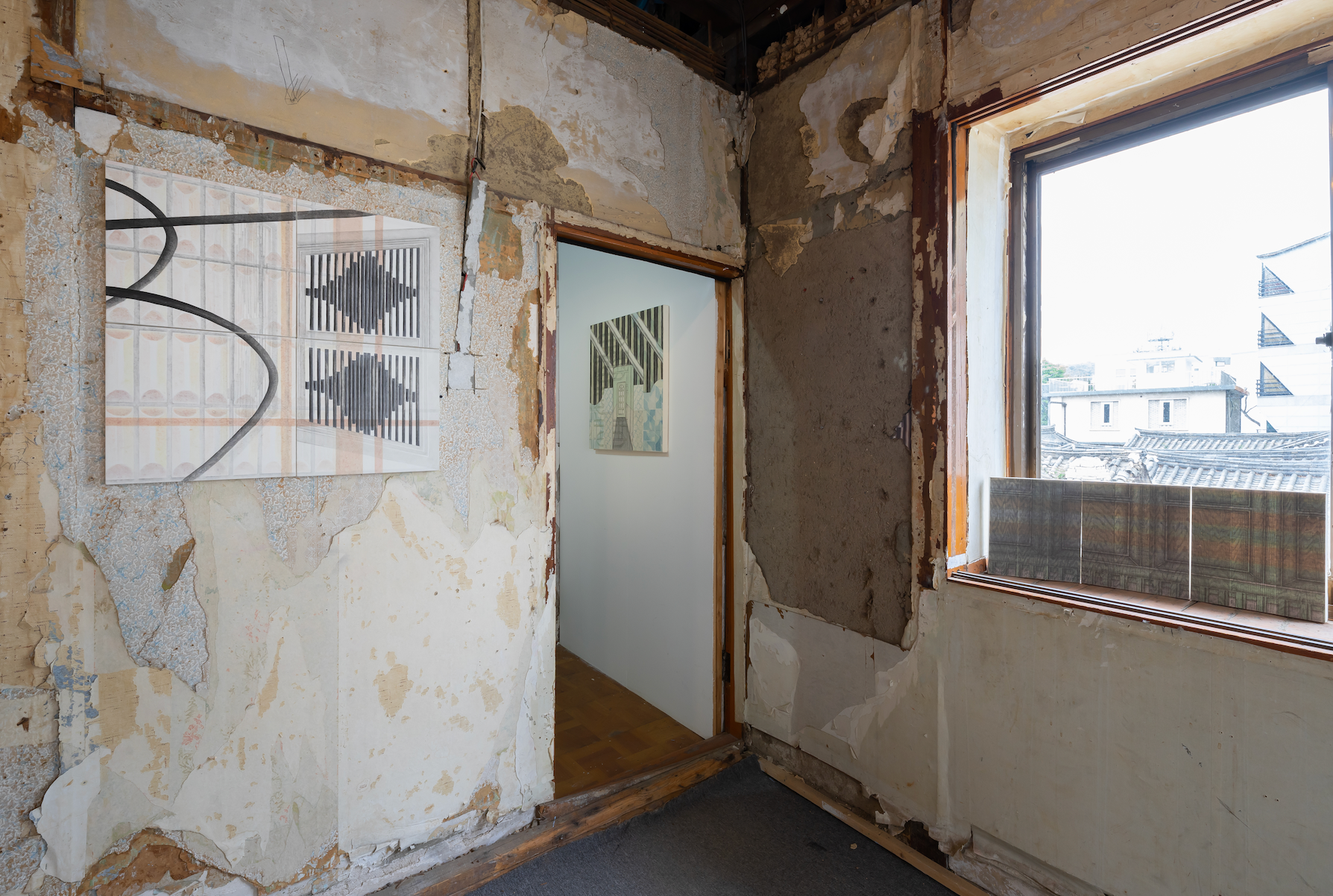
이러한 맥락에서 그의 작품이 함의하는 바를 상기해보면, 작가가 여러 곳을 오가며 얻었던 주관적 감각이 엮여 완성된 그림들은 많은 이들의 조각난 시간들이 모여 교차하는 여관의 상징적 의미와 연동될 가능성을 점쳐볼 수 있다. 필자는 전시장에서 작품의 일부가 실제 장소와 긴밀하게 엮여 새로운 해석의 확장 가능성을 제시하는 몇몇 순간을 만날 수 있었다. 가령 전시장의 계단 난간의 비탈진 선은 <Window>(2021)의 굵은 선들의 연장선이 되어 사람이 오르내리는 이동 방향을 떠올리게 하고, 역으로 작품이 여관의 비어있는 골조를 채워주고 있는 모양새로 보이기도 한다. 줄지어 선 <Balcony Drawing>(2021)는 그림을 감싼 유리면이 여관의 풍경을 흡수하며 그림 위에서 어른거리는 반영(反影)이 된다. 두꺼운 선들의 반복적 배치가 도드라지는 <Curve 3>(2021)은 여관 지붕을 받치는 서까래의 그림자가 되어주고 있었다. 작품은 공간의 배경으로서 기능하기도 하고 독립적인 체계로서 스스로 목소리를 내기도 하며 《외곽》이라는 한 편의 시나리오를 그려 나간다.
필자는 여전히 작가의 눈과 귀, 발과 손이 도시의 어디에 머무는지, 무엇보다 어디로 향해 가고자 하는지 짐작하기 어렵다. 어쩌면 그 역시도 앞으로는 또 어디로 발걸음을 옮겨야 하는지, 어떤 새로운 감촉들을 쌓아낼 것인지 고심하고 있기 때문일지 모르겠다. 김혜숙에게 현실의 이미지는 때로 손바닥 두 개면 충분히 가려질 만큼 작고, 또 어떤 때에는 작가의 신체가 인식할 수 있는 범위를 넘어서는 무한한 것으로 다가올 것이다. 그리고 그의 작업은 그가 느끼듯 우리 모두에게도 도시란 지극히 평범한 것들이 모여 구축하는 물리적 층위이면서, 동시에 예상치 못했던 상상의 장면을 시시각각 발견할 수 있는 곳임을 다시금 이야기해 주고 있다.
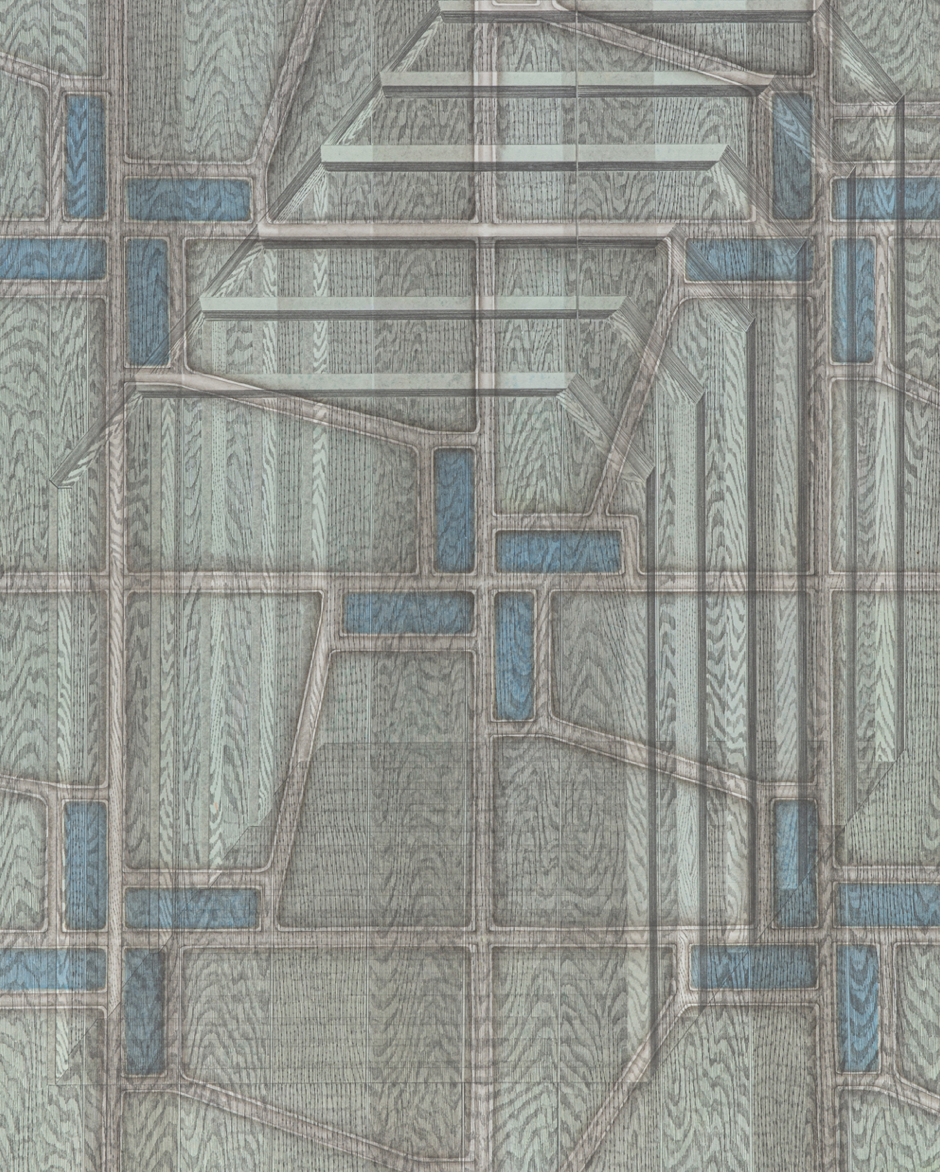
Mozaic Tile, 2019
장지에 샤프펜슬, 먹, 채색_91×65cm
Mechanical pencil, Ink, Color on Jangji_91×65cm
How to paint the skin of a city
By Park Jihyung Independent Curator
Let's talk about overlap. For Kim Hyesook, layered structures are the core and conceptual base of her work. The layers of materials are left behind in a sector where she meticulously renders something. This proves that she has spent a lot of time on paper bringing back her memories and fabricating forms. Different optical angles also overlap in a single scene, signifying that she views a city with a three-dimensional attitude. That is, texture that stands out in her oeuvre is thought of as the layers of light and shade of the paints seeped into a thin piece of paper and traces of a mechanical pen's lead. What do these layers stand for?
Forms piled up are symbols condensed through her experimentation in which the artist converts the spatial context of reality to a temporal context. As these are illustrated after observing different aspects of a city, her pictures are thought of as representing a scene at specific times. Then, can her work be written as an independent genre of landscape painting. Neutral places her eye contacts soon come into the arena of landscapes with some meaning. Highlighting artificial objects or architectural structures, Kim hyesook brings marginalized time to a pictorial frame. And yet, small and large particles drawn out from a city become the basis for incarnating an imaginary world instead of being used to comprehensively record the real. The ever-changing dynamic aspects of a city illustrated through a gradual progress of rhythmical lines, color's light and shade in contrast with a building material's texture, and an audacious division of frames are newly positioned as a visual unit, losing their concrete placeness and historicity. Accordingly, we come to realize that too many arbitrary, connotative principles of operation are immanent in her works to make a hasty conclusion that her picture is a landscape painting taken from reality.
Kim Hyesook didn't initially work on paintings approximating works of geometric abstraction. Pieces she produced until the mid-2010s were quite different. In the series 〈Jangmi-dong〉(2015-16) she involved what she had observed in Gunsan. This series features considerably concrete frameworks, underscoring an unrealistic combination and expansion of architectural components. These frameworks seem reconstructed after observing a floor plan from various angles, as if looking at it from a bird's-eye view, which seems to reflect her will to create some theatrical scene. The completed works lead viewers to envisage some physical experience probably possible only in a virtual scene.
Unlike this, her pieces displayed at the exhibition 《Frame》(2021) more freely arrange artistic clues extracted from artifacts and reappropriate them in accordance with arbitrary regulations. Thus, some abstract patterns shaped as structures are extended while others are reduced. As the curves of spiral stairs, grids on the tile floor, shapes of windows, and texture of the wooden floor appear crossed, the viewer comes to concentrate on interpreting visual rhythms arising from quotidian stray thoughts rather than picturing some three-dimensional sensation before a reproduction presented by the artist. The sensation of speed, balance, and tension brought forth by a combination of minutely placed geometric forms stands out in series such as 〈Mosaic Tile〉(2019) and 〈Curve〉(2021). This formal change implies that there has been a gradual shift in the artist's viewpoint, emotional state, and way of internalizing the city. That is to say, this is the result that reflects her striving aggressively to adjust the distance between space and body, occupying herself in observing reality seen in a long shot or in close-up.
Another point we should not overlook is how her work is associated with the symbolic meaning of Artspace BOAN1942. Artspace BOAN1942 has been both an eyewitness that has kept an eye on changes in the city of Seoul for over 60 years and a platform for mediation that connects to a multitude of people's memories. The woven warp of the past is left in each room of its building. Puzzle-like images are heaped up like the weft. Any exhibition held at a site with historical specificity always works as an ambivalent variable. Thus, how we can draw out an organic relation between the exhibit space's specificity and the work's concept should be fully considered.
If harking back to what her works connote in this context, her pictures completed by weaving her subjective feelings she had from many sites might be associated with the inn's symbolic meanings. Closely involved with an actual site at the venue, I could meet some moments which become part of her artwork to present new interpretations. For example, a steep line of the stair railings becomes an extension of the thick lines in 〈Window〉(2021), signaling direction of ascending and descending, and this work also reversely seems to fill the empty framework of the inn. The surfaces of glass wrapping 〈Balcony Drawing〉(2021) that stands in a row absorb its scene and present glimmering reflections. 〈Curve 3〉(2021) in which a repetitive arrangement of thin lines stands out becomes the shadow of the rafters supporting the inn's roof. These pieces are writing a scenario of 《Frame》, functioning as the background of its space and uttering their voice as a freestanding system.
It is still hard to guess where the artist and her spirit are headed. Perhaps, she still studiously considers where she has to move forward or what new senses she has to accumulate. To Kim hyesook, images from reality are at times too small to be covered by two palms and are at times thought of as something infinite that exceeds some range her body can perceive. Her work holds that, as she feels, a city is a physical layer shaped with extremely ordinary things as well as a site where we can discover some scenes we have never imagined.
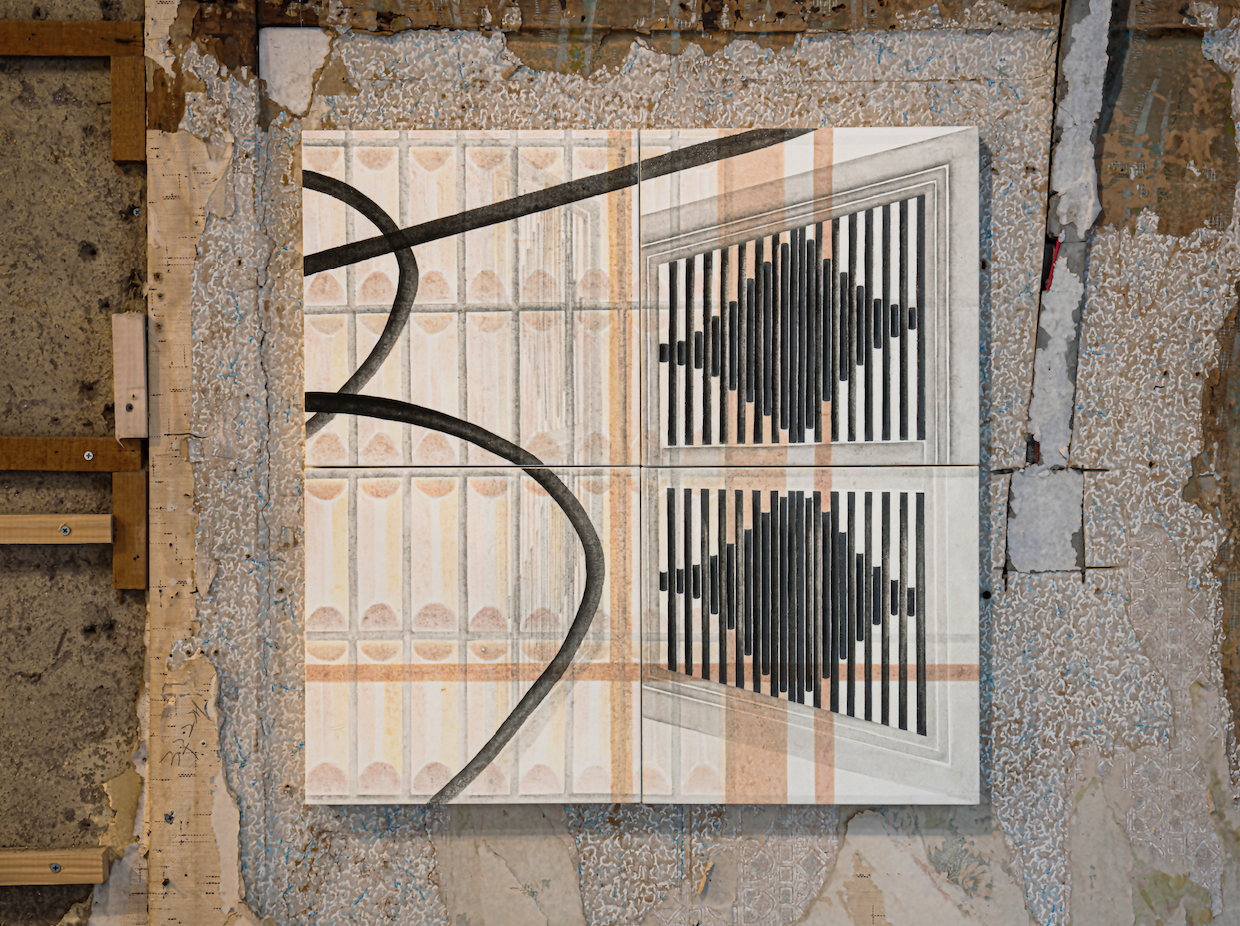
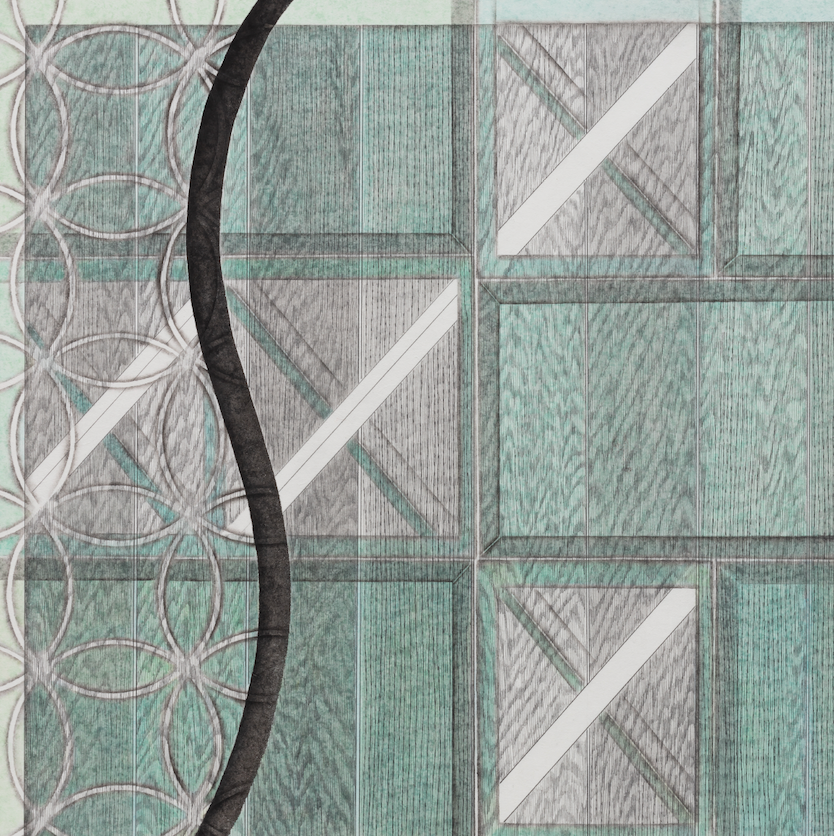
Round Straight Line, 2021
장지에 샤프펜슬, 먹, 채색_60×60cm
Mechanical pencil, Ink, Color on Jangji_60×60cm