
하나의 선으로부터, 색에서 빛으로
임지연 / 소마미술관 큐레이터
From One Line, Color to Light
By Lim jiyeon, Curator of SOMA
도시는 끊임없이 생산과 소멸을 반복한다. 시기에 따라 유행하듯 너도나도 특정 양식을 차용하여 지어진 건축물들은 시간이 지남에 따라 그만의 모습으로 변화한다. 낡은 건물의 오래전 유행했을법한 문양의 창틀과 계단의 난간, 문의 문양 등은 일시적인 풍경이면서 일상적인 풍경이고, 누적된 시간을 담은 공간은 기억 속에 스며들듯 자리를 잡는다. 누구나 옛집에 대한 기억을 떠올리며 살 듯 우리는 공간 속에 머무르며 함께 살아 숨 쉰다. 경험이 가능한 미적 대상인 건축물, 일상 속 너무도 익숙해진 공간을 친숙하면서도 낯설게 바라보기. 김혜숙은 이러한 공간의 외벽, 창문, 지붕, 난간 등에서 형상을 추출하고 가장 기본 요소인 '선'으로부터 시선의 흐름대로 드로잉 작업을 한다.
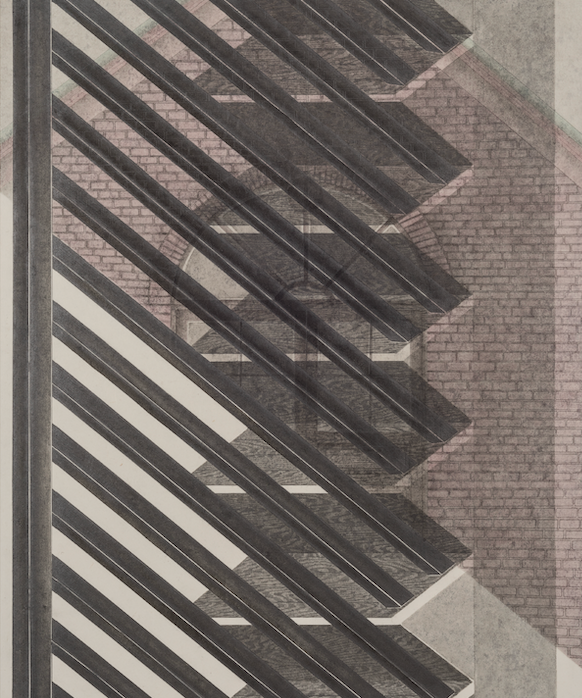
그렇기에 작가의 모든 작업의 정체성은 시선으로 시작하여 시선으로 완성된다. 실재하는 공간을 바라볼 때의 시선의 흐름, 공간 속 선들을 따라 움직이는 작가의 시선은 매우 예리하면서도 간결하다. 공간 속 흩어진 선들 중 어느 선 하나에 시선이 머무르면 이는 선을 따라 쭉 이어진다. 선이 이어져 하나의 기하학을 그려내고, 새로운 면을 만들어내는 것을 흥미롭게 바라보는 것이다. 그리고 이는 곧 드로잉의 선이 된다. 대상을 해체하고 시선을 이동하며 바라본 직선과 곡선은 공간 안에서 새로운 시각을 만들어내고, 그 흔적들은 중첩적 표현방식으로 시간성과 공간성을 한데 어우러지게 한다. 마치 하나의 건축물을 짓듯이 선은 그렇게 장지 위에 켜켜이 쌓인다. 반복과 중첩을 통해 선은 직선, 그리고 곡선으로 유려하게 뻗어나간다. 얇은 장지에 스며들며 옅은 레이어를 만드는 먹과 물감, 섬유질의 미세한 틈 사이로 박힌 샤프의 흑연은 건축물에서 추출한 형상들을 서로 이질적인 느낌이 들지 않게 은은하게 포개어내고, 공간에 담긴 시간까지도 배어나오게 하는 효과를 자아낸다.
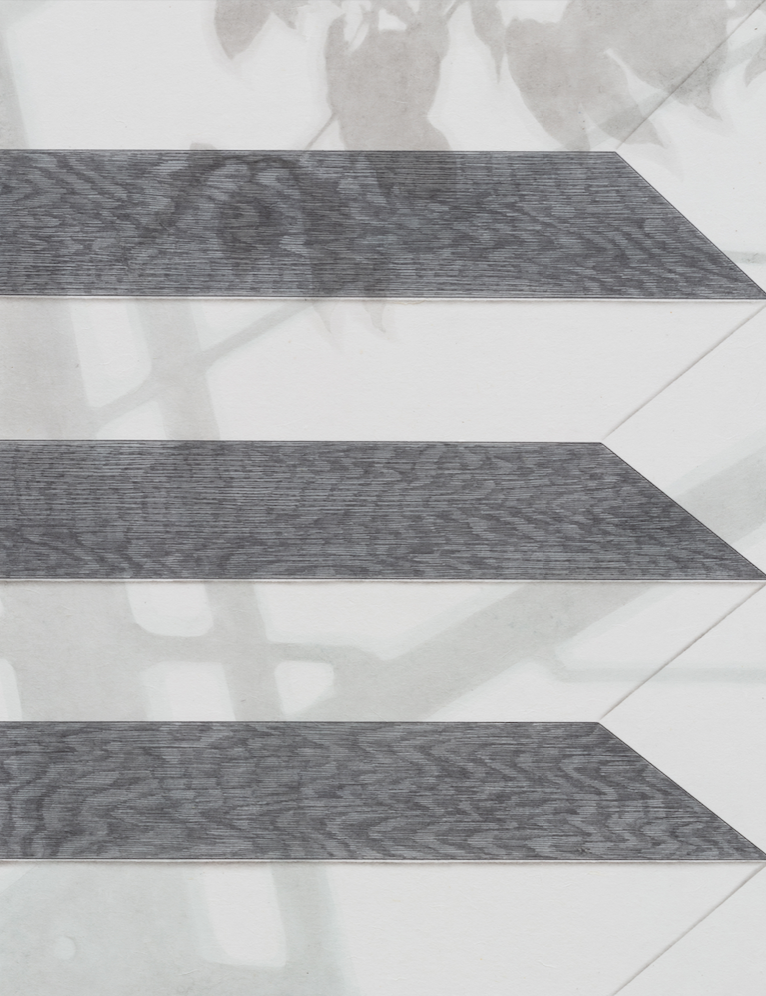
이번 전시의 작품의 가장 큰 특징은 인공물에서 차용한 모티프에 자연물이 만들어낸 선과 공간을 새롭게 끌어왔다는 점이다. 자연물이 그리는 곡선은 기존의 작업에서의 발랄한 곡선을 부드럽고 세밀하게 다듬어냈고, 자연물이 만들어낸 그늘은 공간에 대한 개념으로 차용되어 기존에 그가 담아낸 인공물의 공간에 자연스레 녹아들었다. 색의 차용 역시 기존의 건축물에 쓰인 색에서 자연물이 가진 색으로 바뀌었다. 흑과 백으로 존재하던 초기 작업에서 이전에는 '색깔'이 새롭게 들어왔다면, 이번 작업에는 '빛깔'이 들어온 것이다. 빛을 끌어오니 작품은 한층 더 따뜻해졌다. 동이 트고 지는 무렵의 하늘의 빛, 따사로운 햇볕에 비쳐 만들어진 그늘은 작가가 사용하는 재료와 기법을 만나 마치 몸에 꼭 맞는 옷을 입은 것처럼 더없이 편안하고 자연스레 어우러져있다.
이렇게 공간을 섬세하게 포착하여 담아낸 김혜숙의 작품은 실재 공간에 들어왔을 때 공간 내 모티프들과 자연스레 이어지고 확장된다. 작품 내 모티프와 실재 공간의 모티프가 한데 어우러져 친숙한 이음과 변주를 그려내어 재미를 더할 뿐만 아니라 실재 공간에서의 새로운 해석에 대한 확장까지도 가능하게 한다. 그리고 이러한 확장성은 무한하게 작용한다. 인공물과 자연이 만들어낸 선과 면이 중첩되고 자연의 빛과 색을 담아낸 그의 작품을 바라보고 있으면 머물렀던 공간에 대한 경험이 함께 중첩되는 순간을 만날 수 있다. 특히 그늘이라는 자연 속 공간을 표현하기 위해 작품에 담아낸 나무의 그림자는 필자에게 마치 나무 그늘 아래 서 있는 듯한 상상을 불러일으키는 요소로 다가왔다. 그리고 상상 속 풍경은 어떠한 소리까지도 함께 떠오르게 한다. 낡은 담장에는 나무의 그림자가 비치는 어느 오후, 바람에 나뭇잎이 흔들리고 새가 지저귀며 풀벌레 울음소리가 들리는 순간의 풍경, 그리고 어디선가 들려오는 사람들의 말소리와 웃음소리가 들려올 것 같은 익숙한 주택가의 풍경. 시기별 유행하는 건축 자재와 문양들의 선으로 켜켜이 쌓인 오래된 주택에서 바라보는 더없이 친숙한 일상의 소리를 말이다. 반복과 중첩으로 배어 나오듯 보이는 선과 색은 공간에 시간을 더하여 담아내고자 하는 작가의 의도를 잘 풀어내어 기억과 상상 속 공간까지의 확장 가능성을 제시한다. 공간의 확장뿐만 아니라 시간의 확장, 그리고 실재에서 상상으로의 확장까지 김혜숙의 작품이 지니는 확장성은 이렇게 무한하다. 그만이 지닌 예리한 시선과 따스한 감성이 또 어떤 선을 뻗어내고, 머무른 시간에 배인 빛을 담아낼지 무척 기대가 된다.
A city consistently repeats production and extinction. Buildings and other structures built in a specific style are transformed as time passes by. A worn-out building's window patterns, stair handrails, door designs, and others elements that were likely in fashion a long time ago are either temporary scenes or everyday landscapes. The space holding accumulated time takes its place, seeping into our memory. Just as everyone lives, recalling the memory of their old home, we stay in a space and are alive together. An architectural structure as an aesthetic object possible to experience, looking at familiar space in our everyday life in an unfamiliar way...... Kim Hyesook draws out forms from such space's outer walls, windows, roofs, and handrails, and then works in drawing with lines, the most fundamental element of drawing depending on the flow of her gaze
What makes up a large part of her work's identity is her gaze: All of her works start from her gaze and are completed by her gaze. Her gaze, which moves along lines in space, is really acute and succinct when looking at a real space. When her eyes linger on one line among lines scattered in space, this continues along this line. This means she takes interest in a process in which a geometric image is drawn and a new plane is brought about Straight lines and curves seen while dismantling objects and moving eyes create a new point of view in space, and their traces make both temporality and spatiality come into harmony with each other in an overlapping expressive way. As if to build a structure, lines are heaped up in layers on thin paper. Either straight lines or curves are fluently stretched out through repetition and superposition, Ink and paint that brings about thin layers by filtering into thin paper and graphite from mechanical pencil lead stuck in the fine cracks of fiber serenely overlap images extracted from architectural structures that do not feel foreign to one another, arousing an effect that time held in space oozes out.
The most salient feature of works on show at this exhibition is the application of the lines and spaces that natural objects have to motifs borrowed from artificial objects. The curves of a natural object serve to refine lively and vivacious curves found in her previous pieces while the shade engendered by a natural object filters naturally into the space of an artificial object, appropriated as the notion of space. The borrowed colors have changed from those of buildings to those of natural objects. While hues are adopted for works on display at this show, 'colors' were newly employed for her early black and white pieces. As light draws into her works, they look much warmer The light from the sky at sunrise and sunset and the shade generated by warm sunlight are in accord comfortably and naturally with the materials and techniques she employs.
When her work capturing a space is delicately set in actual space, it is naturally connected and extended to motifs in this space. Her works produce a sense of fun through connection and variation arising when the motifs in her works are in harmony with those in real space. This also makes a new interpretation in actual space possible. And this expandability works infinitely. When looking at her works in which lines and planes engendered by both natural and artificial objects overlap. and natural light and color are held, we come across the moment our experiences with the space where we stayed overlap. The shade of a tree she captured to express the shade as a space in nature is adopted as an element to spark the imagination and feel as if standing under the shade of a tree. And, imaginary scenes can also bring to mind some sounds. There is birdsong and grass bug sounds heard from a momentous scene one afternoon when a tree casts its reflection on a worn- out wall, and its leaves stir in the wind; speaking voices and laughing voices likely to be heard from some residential area; and friendly everyday sounds heard from old houses in which the lines of architectural materials and patterns are amassed in layers. The lines and colors that seem to ooze out through repetition and superposition set out the possibility of extending space in memory and imagination, superbly interpreting her intention to forge her images through a combination of space and time. The expandability of Kim's work is infinite: not only expansion in space and time but also expansion in imagination. That's why her work is quite interesting. We can anticipate the lines her own keen eyes and warm emotions spread out and her works to contain a light tinged with time.
도시의 피부를 그리는 방법
박지형 (독립 큐레이터)
How to paint the skin of a city
By Park Jihyung Independent Curator
겹쳐지는 것들에 대해 말해보자. 김혜숙에게 겹 구조는 작품 제작 방식의 핵심이자 개념적인 근거이다. 작가의 손이 꼼꼼히 훑어간 자리에는 어김없이 질료의 쌓임이 남는데, 이는 그가 기억을 되새기며 형상을 만들어내는 데 적지 않은 시간을 종이 위에서 보냈음을 증명한다. 여러 시점의 이동 역시 한 화면 안에 중첩되어 그가 도시를 바라보는 입체적인 태도를 함축적으로 나타낸다. 말하자면 그의 작업 전반에서 도드라지는 질감은 얇은 종이의 결 사이로 스며든 물감의 여러 농담과 샤프의 얇은 흑연이 밟고 지나간 흔적의 레이어다. 이 층위들은 무엇의 지표인가?
포개어진 형태들은 작가가 현실의 공간적 맥락을 시간 축의 영역으로 변환하는 실험 속에서 압축된 기호이다. 도시의 여러 장면들을 관찰하여 그린 그림이므로, 작품들은 특정한 시기의 풍경을 대변한다고도 할 수 있겠다. 연이어 드는 생각은 과연 그의 작업 세계를 풍경화라는 독립된 장르로 명명할 수 있을까 하는 점이다. 작가의 시선이 닿은 중성적인 장소들은 곧 의미를 갖는 풍경의 영역 안으로 들어온다. 특히 자연이 아닌 인공적인 사물이나 건축물 등에 집중하는 그는 누군가의 시선을 비켜나갔던 주변부의 시간을 회화적 프레임 안으로 소급시킨다. 그러나 도시로부터 추출된 크고 작은 입자들은 실재에 관한 총체적인 기록에 동원되는 대신 상상적 세계를 구현하는 근거가 된다. 리드미컬한 선의 점진적 이행, 건축 자재의 질감과 대비되는 색의 명암, 대담한 프레임 분할 등 부단히 그 역할을 달리하는 도시의 역동적인 면면들은 구체적 장소성과 역사성을 상실하고 오롯한 시각적 단위로서 새롭게 위치한다. 따라서 그의 그림을 리얼리티를 담는 풍경화로 속단하기에는 그 이상의 자의적이고 함축적인 작동 원리가 내재하고 있음을 인지하게 된다.
그가 처음부터 기하학적 추상에 가까운 그림을 그렸던 것은 아니다. 작가가 2010년대 중반까지 보여준 작업들은 이와 사뭇 다르다. 작가가 군산에서 머물며 관찰한 것들을 엮어낸 <장미동>(2015-6) 연작의 경우, 한 화면에 제법 구체적인 골조가 들어서며 건축적 구성물들 간의 비현실적인 결합과 확장이 강조되어 있다. 특히 평면도를 여러 시점에서 관찰하고 부감하듯 이리저리 재조합한 느낌을 주는데, 하나의 연극적 장면을 연출하고자 하는 작가의 의지를 반영하는 듯하다. 따라서 완성된 작품들은 가상의 장(scene)안에서 가능할 법한 신체적 경험을 상상하게끔 유도한다.
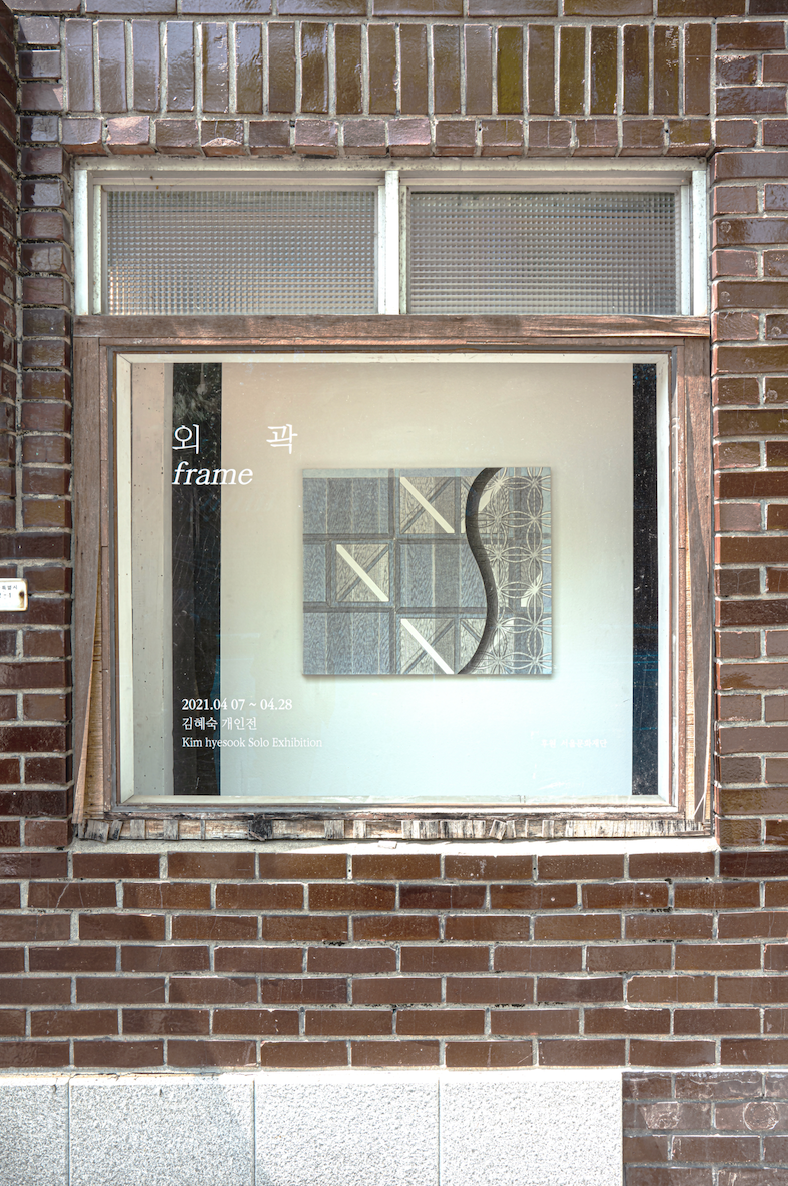
이와는 달리 전시 《외곽》(2021)에서 선보인 작업들은 인공물로부터 추출한 조형적 단서들을 보다 자유롭게 배치하고 이를 임의의 규칙에 따라 재전유하고 있다. 따라서 어떤 구조물은 아주 크게 확대되고 또 다른 부분은 작게 축소되며 추상적 패턴을 형성한다. 나선형 계단의 굴곡, 타일 바닥의 그리드, 창문의 형태와 나무 바닥의 질감은 화면 전면부에 교차되며 나타나므로, 관객은 작가가 제시하는 재현 앞에서 3차원적 감각을 상상하기보다는 일상적 단상들이 직조하는 시각적 리듬을 읽어내는 데 집중하게 된다. <Mosaic Tile>(2019-21)이나 <Curve>(2021) 연작의 경우 세밀하게 배치된 기하학적 형상의 조합이 만들어내는 균형과 긴장, 속도감 등이 도드라지는 것을 볼 수 있다. 이러한 형식 상의 변화는 실제 작가의 관찰 시점과 감정적 상태, 또 도시를 체화하는 방식이 점진적으로 이동했다는 것을 이야기한다. 즉 이는 작가가 때로는 원거리에서, 또 때로는 근거리에서 현실에 몰두하며 공간과 신체 사이의 거리를 적극적으로 조율하기를 멈추지 않는 자세가 반영된 결과이다.
이와는 달리 전시 《외곽》(2021)에서 선보인 작업들은 인공물로부터 추출한 조형적 단서들을 보다 자유롭게 배치하고 이를 임의의 규칙에 따라 재전유하고 있다. 따라서 어떤 구조물은 아주 크게 확대되고 또 다른 부분은 작게 축소되며 추상적 패턴을 형성한다. 나선형 계단의 굴곡, 타일 바닥의 그리드, 창문의 형태와 나무 바닥의 질감은 화면 전면부에 교차되며 나타나므로, 관객은 작가가 제시하는 재현 앞에서 3차원적 감각을 상상하기보다는 일상적 단상들이 직조하는 시각적 리듬을 읽어내는 데 집중하게 된다. <Mosaic Tile>(2019-21)이나 <Curve>(2021) 연작의 경우 세밀하게 배치된 기하학적 형상의 조합이 만들어내는 균형과 긴장, 속도감 등이 도드라지는 것을 볼 수 있다. 이러한 형식 상의 변화는 실제 작가의 관찰 시점과 감정적 상태, 또 도시를 체화하는 방식이 점진적으로 이동했다는 것을 이야기한다. 즉 이는 작가가 때로는 원거리에서, 또 때로는 근거리에서 현실에 몰두하며 공간과 신체 사이의 거리를 적극적으로 조율하기를 멈추지 않는 자세가 반영된 결과이다.
간과해서 안될 또 다른 지점은 작품을 보안여관이라는 상징적인 의미의 영역과 어떻게 연결 지을까 하는 것이다. 보안여관은 60여 년이 넘는 시간 동안 서울이라는 한 도시의 변화를 묵묵히 지켜보며 서있었던 목격자이자 수많은 사람들의 기억과 연결된 매개의 플랫폼이다. 이제는 골조만 남은 건물의 방 구석구석에는 여전히 과거의 씨실이 짜여 남아있다. 그리고 이곳에 작가가 만든 퍼즐과도 같은 이미지가 날실처럼 엇갈려 올라선다. 역사적 특수성을 띤 무대에서의 전시는 언제나 양가적인 변수로 작동한다. 한편으로 이러한 시도는 작품의 개별적인 의미가 축소되거나 장소의 에너지에 작가의 의도가 함몰될 위험을 안는다. 그러므로 전시장의 특수성과 작품의 개념 간에 어떻게 유기적 관계를 이끌어 낼 것인지가 충분히 고려되어야 한다.
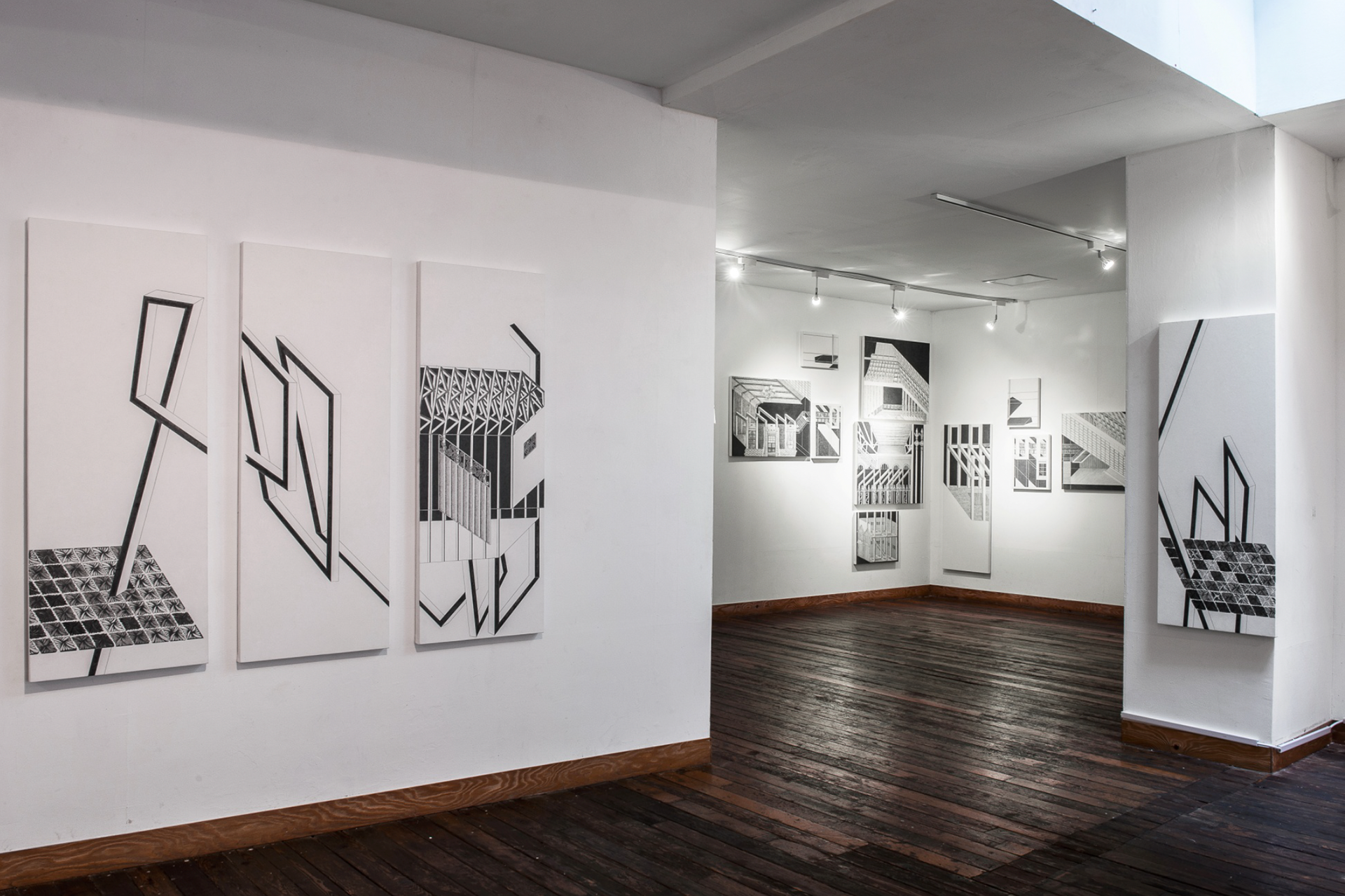
이러한 맥락에서 그의 작품이 함의하는 바를 상기해보면, 작가가 여러 곳을 오가며 얻었던 주관적 감각이 엮여 완성된 그림들은 많은 이들의 조각난 시간들이 모여 교차하는 여관의 상징적 의미와 연동될 가능성을 점쳐볼 수 있다. 필자는 전시장에서 작품의 일부가 실제 장소와 긴밀하게 엮여 새로운 해석의 확장 가능성을 제시하는 몇몇 순간을 만날 수 있었다. 가령 전시장의 계단 난간의 비탈진 선은 <Window>(2021)의 굵은 선들의 연장선이 되어 사람이 오르내리는 이동 방향을 떠올리게 하고, 역으로 작품이 여관의 비어있는 골조를 채워주고 있는 모양새로 보이기도 한다. 줄지어 선 <Balcony Drawing>(2021)는 그림을 감싼 유리면이 여관의 풍경을 흡수하며 그림 위에서 어른거리는 반영(反影)이 된다. 두꺼운 선들의 반복적 배치가 도드라지는 <Curve 3>(2021)은 여관 지붕을 받치는 서까래의 그림자가 되어주고 있었다. 작품은 공간의 배경으로서 기능하기도 하고 독립적인 체계로서 스스로 목소리를 내기도 하며 《외곽》이라는 한 편의 시나리오를 그려 나간다.
필자는 여전히 작가의 눈과 귀, 발과 손이 도시의 어디에 머무는지, 무엇보다 어디로 향해 가고자 하는지 짐작하기 어렵다. 어쩌면 그 역시도 앞으로는 또 어디로 발걸음을 옮겨야 하는지, 어떤 새로운 감촉들을 쌓아낼 것인지 고심하고 있기 때문일지 모르겠다. 김혜숙에게 현실의 이미지는 때로 손바닥 두 개면 충분히 가려질 만큼 작고, 또 어떤 때에는 작가의 신체가 인식할 수 있는 범위를 넘어서는 무한한 것으로 다가올 것이다. 그리고 그의 작업은 그가 느끼듯 우리 모두에게도 도시란 지극히 평범한 것들이 모여 구축하는 물리적 층위이면서, 동시에 예상치 못했던 상상의 장면을 시시각각 발견할 수 있는 곳임을 다시금 이야기해 주고 있다.
Let's talk about overlap. For Kim Hyesook, layered structures are the core and conceptual base of her work. The layers of materials are left behind in a sector where she meticulously renders something. This proves that she has spent a lot of time on paper bringing back her memories and fabricating forms. Different optical angles also overlap in a single scene, signifying that she views a city with a three-dimensional attitude. That is, texture that stands out in her oeuvre is thought of as the layers of light and shade of the paints seeped into a thin piece of paper and traces of a mechanical pen's lead. What do these layers stand for?
Forms piled up are symbols condensed through her experimentation in which the artist converts the spatial context of reality to a temporal context. As these are illustrated after observing different aspects of a city, her pictures are thought of as representing a scene at specific times. Then, can her work be written as an independent genre of landscape painting. Neutral places her eye contacts soon come into the arena of landscapes with some meaning. Highlighting artificial objects or architectural structures, Kim hyesook brings marginalized time to a pictorial frame. And yet, small and large particles drawn out from a city become the basis for incarnating an imaginary world instead of being used to comprehensively record the real. The ever-changing dynamic aspects of a city illustrated through a gradual progress of rhythmical lines, color's light and shade in contrast with a building material's texture, and an audacious division of frames are newly positioned as a visual unit, losing their concrete placeness and historicity. Accordingly, we come to realize that too many arbitrary, connotative principles of operation are immanent in her works to make a hasty conclusion that her picture is a landscape painting taken from reality.
Kim Hyesook didn't initially work on paintings approximating works of geometric abstraction. Pieces she produced until the mid-2010s were quite different. In the series 〈Jangmi-dong〉(2015-16) she involved what she had observed in Gunsan. This series features considerably concrete frameworks, underscoring an unrealistic combination and expansion of architectural components. These frameworks seem reconstructed after observing a floor plan from various angles, as if looking at it from a bird's-eye view, which seems to reflect her will to create some theatrical scene. The completed works lead viewers to envisage some physical experience probably possible only in a virtual scene.
Unlike this, her pieces displayed at the exhibition 《Frame》(2021) more freely arrange artistic clues extracted from artifacts and reappropriate them in accordance with arbitrary regulations. Thus, some abstract patterns shaped as structures are extended while others are reduced. As the curves of spiral stairs, grids on the tile floor, shapes of windows, and texture of the wooden floor appear crossed, the viewer comes to concentrate on interpreting visual rhythms arising from quotidian stray thoughts rather than picturing some three-dimensional sensation before a reproduction presented by the artist. The sensation of speed, balance, and tension brought forth by a combination of minutely placed geometric forms stands out in series such as 〈Mosaic Tile〉(2019-21) and 〈Curve〉(2021). This formal change implies that there has been a gradual shift in the artist's viewpoint, emotional state, and way of internalizing the city. That is to say, this is the result that reflects her striving aggressively to adjust the distance between space and body, occupying herself in observing reality seen in a long shot or in close-up.
Another point we should not overlook is how her work is associated with the symbolic meaning of Artspace BOAN1942. Artspace BOAN1942 has been both an eyewitness that has kept an eye on changes in the city of Seoul for over 60 years and a platform for mediation that connects to a multitude of people's memories. The woven warp of the past is left in each room of its building. Puzzle-like images are heaped up like the weft. Any exhibition held at a site with historical specificity always works as an ambivalent variable. Thus, how we can draw out an organic relation between the exhibit space's specificity and the work's concept should be fully considered.
If harking back to what her works connote in this context, her pictures completed by weaving her subjective feelings she had from many sites might be associated with the inn's symbolic meanings. Closely involved with an actual site at the venue, I could meet some moments which become part of her artwork to present new interpretations. For example, a steep line of the stair railings becomes an extension of the thick lines in 〈Window〉(2021), signaling direction of ascending and descending, and this work also reversely seems to fill the empty framework of the inn. The surfaces of glass wrapping 〈Balcony Drawing〉(2021) that stands in a row absorb its scene and present glimmering reflections. 〈Curve 3〉(2021) in which a repetitive arrangement of thin lines stands out becomes the shadow of the rafters supporting the inn's roof. These pieces are writing a scenario of 《Frame》, functioning as the background of its space and uttering their voice as a freestanding system.
It is still hard to guess where the artist and her spirit are headed. Perhaps, she still studiously considers where she has to move forward or what new senses she has to accumulate. To Kim hyesook, images from reality are at times too small to be covered by two palms and are at times thought of as something infinite that exceeds some range her body can perceive. Her work holds that, as she feels, a city is a physical layer shaped with extremely ordinary things as well as a site where we can discover some scenes we have never imagined.
나에게 청하는 악수, 감각의 집을 찾아서
방유경(독립기획)
A handshake asked to me, in search of a house of senses
By Bang Yukyung, Independent Curator
김혜숙은 샤프펜슬을 가지고 근대건축물의 공간과 구조, 건축적 요소들을 해체하고 재구성하는 일관된 작업을 보여주었다. 그가 장지 위에 얇은 샤프심을 끊임없이 덧칠하여 구축한 집은 그래서 예리하고 정밀하고 정확하다. 건축도면을 보는듯한 착각을 불러일으킬 만큼, 섬세하다 못해 완벽에 가까운 재료와 부재 묘사를 보면 그림에 강력한 현실성을 부여하겠다는 작가의 의지가 오롯이 느껴진다. 노동집약적인 그의 작업을 보노라면 자연스레 ‘왜 그리는가?’에서 ‘왜 그려야만 하는가?’로 귀결되는 질문이 떠오른다. 하지만 이 물음 이면에는 반드시 거쳐야 하는 보다 근본적인 두 가지 질문이 존재한다. “왜 근대건축물일까?” 그리고 “왜 샤프일까?” 관객의 시점에서 던진 이 질문의 주어를 작가로 바꾸면, 이는 곧 ‘무엇을 어떻게 보여줄 것인가?’하는 문제로 치환된다.
아이러니하게도 나는 누구보다 작가 자신이 이 질문에 답하기 위해 현재의 작업에 다다르게 되었다는 생각에 든다. 스스로 발견했지만, 동시에 이끌린 것이다. 근대의 양식으로 지어진 오래된 건축의 무엇이 그를 사로잡았을까? 종이 위에 재료를 얹는 것이 아니라 에칭을 하듯 얇은 선을 따라 한 가닥 한 가닥 파내어 새기는 행위는 무엇을 의미할까?
누구나 이름 지을 수 없는 기억의 시간을 가지고 있다. 날 것의 상태로 그냥 묻어두거나, 굳이 꺼내어보지 않은 시간, 혹은 꺼내보기 두려운 시간. 이러한 시간은 어떤 쓸모로서 환원되지 못한 채, 망각의 어디에 뒤엉켜 차곡차곡 쌓인다. 더듬어 보면, 우리는 뚜렷하게 의미를 부여하거나 설명할 수 있는 선택적 기억을 가지고 자아라는 존재의 집을 짓는다. 이성으로 지은 집은 번듯하고 체계적이다. 그러나 이 자아를 지탱하고 있는 무의식이라는 지층은 체계적이지도 균일하지도 않다. 언제 어디서부터 엉켰는지 알 수 없는 기억의 입자들이 뒤엉켜 있다. 그래서 이 지층 위에 지은 집은 사실 불완전하다. 군데군데 알 수 없는 균열들이 있지만 이 균열의 원인을, 시작점을 알 수 없다.
김혜숙이 탐구하는 근대건축의 공간은 어쩌면 스스로 묻어두었던 시간, 뒤엉킨 지층의 다른 모습일지도 모른다. 무엇으로 번역된 적 없는 이 기억 속에서 그가 건저올린 재료들은 현재 눈에 보이는 삶(집)의 균열과 이어져 있다. 버려진 집, 쓸모를 잃은 공간, 이른바 근대건축물로 분류되는 오래된 건축물은 현재 용도가 폐기된 건물이다. 더 이상 그곳에는 사람의 온기도, 잘 나가던 시절의 부흥도 없다. 형태는 있으나 의미를 상실한 공간인 셈이다. 이러한 맥락은 우리가 ‘근대건축’이라 부르는 건축물에 사용된 형태 언어의 특성에 부합한다.
우리의 향수를 자극하는 고전 양식의 건축물들은 서양 역사에 뿌리를 내리고 있다. 건물을 지탱하는 기둥, 보, 계단, 그리고 문, 창, 장식 등 형태 언어들은 기하학에 근거한 완벽한 규범을 따른다. 하지만 우리나라에 지어진 건축의 어휘들은 ‘서양’이라는 구체적인 시공간의 맥락에서 떨어져 나오면서 본래 지닌 의미를 상실한다. 낯선 대한민국 어느 도시에 한복판에 구축된 이 집들은, 그럼에도 근대적 기능의 변용에 충실히대응하며 긴 시간 생존했다. 이 생존의 증거인 ‘시간성’은 작가 개인의 경험과 해석에 따라 건축 형태에 새로운 문맥과 의미를 부여한다. 그래서 김혜숙이 그림을 그리기 위해 가장 먼저 하는 행위는 연구다. 건축의 역사와 배경을 조사한다. 건축학도도 아닌 그가 아카이브를 구축하듯 탐구하는 데는 불안이라는 기재가 작동하고 있다. ‘미지의 대상’에 대한 접근은 일차적으로 지적 센서를 작동하기 마련이다. 하지만 자신을 끌어당긴 집에 대한 탐구는 지적 울타리를 확보한 다음 구체적으로 감각을 통해 실행된다. 근대건축 요소의 조합을 끈끈하게 묶어주고 지탱하던 규범이라는 연결고리가 기능을 잃고 느슨해지자, 각 부분은 분절적으로 떨어져나간다. 김혜숙은 이렇게 느슨하게 분리된 건축의 형태 언어를 자신의 감각으로 새롭게 재구성한다. 수리된 시점이나 사용자의 기호에 따라 제각각 다른 모습을 한 문고리에서 따온 전시 타이틀처럼, ‘문고리 하나’를 잡는 순간 그가 구축한 세계로 들어가는 문이 열린다.
사실 공간을, 집의 안팎을 인식하는 행위는 단순히 지적 차원을 넘어선 의미를 가진다. 인간에게 집이란 외부와 만나는 첫 세계이자, 자아라는 존재의 집을 구축하는 근원이고 바로미터이기 때문이다. 갓 태어난 아기는 이성이 아닌 신체의 모든 감각을 동원하여 바깥세상과 나를 분리하고 그 경계를 인지한다. 몸을 지탱하는 골격, 신진대사를 관장하는 기관, 이 모든 것을 감싸고 나를 보호하는 최후의 경계막인 피부. 보고, 듣고, 만지고, 디디고, 냄새를 맡아 얻은 모든 정보를 종합하여 존재의 집을 구축하는 것이다. 그래서 집, 나아가 건축은 엄마의 품처럼 한 인간이 성장하는 모든 순간에 관여한다. 다시 말해 집이란 상징적으로 물리적으로 내 몸이 확장된 또 하나의 세계다.
김혜숙이 예민한 ‘감각’을 통해 경험한 근대건축은 스스로 구축해야만 하는, 혹은 대면해야 하는 또 다른 자아의 세계다. 그의 그림에 등장하는 재료의 표현을 보면 자신의 살과 숨으로 얼마나 체화한 재료들인지 짐작할 수 있다. 목재나 벽돌, 장식 등 요소들이 지닌 표면의 생생한 묘사는 그가 이 세계를 인식하는 방식을 드러낸다. 장지 위에 깊게 파내려 가듯 샤프펜슬을 눌러 그린 목재의 표면은 손끝으로 나뭇결을 하나하나 쓰다듬듯 강렬한 감각을 상기시킨다. 그에게 샤프펜슬은 감각적 경험을 드러내는 구체적인 방식이었을 것이다.
여기서 주목할 점은 보여주는 방식의 변화다. 벽, 기둥, 계단, 트러스 등 초기작에서 다양한 시점에 맞춰 공간의 얼개를 갖추고 재구성되던 요소들은 거대한 하나의 구조체 형태에서 점차 해체된다. 얽힌 구조물은 원형을 떠올리기 힘들 정도로 초현실적인 공간을 창조한다. 보통 우리가 건축 공간을 경험하고 인지하는 과정은 시퀀스라 불리는 일련의 시간 순서를 따른다. 밖에서 안으로, 혹은 안에서 밖으로 흐르는 시선의 이동은 공간의 깊이를 따라 한 편의 영화를 보듯 펼쳐진다. 하지만 김혜숙이 재현한 공간에는 시간상 선후나 공간의 깊이를 상실한 상징적 요소들이 화면을 채운다. 이 요소들은 평면적으로 겹치며 물성을 섬세하게 드러낸다. 문과 계단, 창과 트러스 등 최소한의 요소들이 한 화면에 오버랩되는데 이러한 시퀀스의 압축은 시공간을 비튼다. 이를 가능하게 한 표현이 바로 근작에 사용된 색이다. <문고리 하나, 악수 한번>에서 작가는 조심스럽게 낮은 채도의 색을 한겹 한겹 덧발라 채도를 올린다. 이는 동양화에서만 재현할 수 있는 시간을 머금은 기법이다. 샤프펜슬 드로잉 위에 색을 올리자 보다 서사적이고 입체적인 새로운 시공간이 구축된다. 극사실의 표현과 기억 속의 환영이 감각을 통해 오버랩되는 기이한 장면이 연출되는 것이다.
처음 근대건축에 영감을 받아 그림을 그리기 시작할 때, 작가는 굉장히 불편한 감정을 느꼈다고 한다. 그림을 그리는 업을 유지하기 위해 숙명처럼 이 도시 저 도시를 유랑하면서 그때마다 만난 근대건축은 그에게 낯설지만 익숙한, 몰라서 두렵지만 결국엔 이해하고 싶은 대상이었다. 죽은 듯 살아있는 듯한 존재와의 긴 싸움은 자신의 또 다른 표상이기도 했다. 현실 이면에 살고 있는 자아의 목소리를 따라 결국은 마주해야만 했던 공간은 결국 작가의 몸에 각인된 긴 시간의 지층과 맞닿아 있었다.
김혜숙은 청주에서의 작업을 돌아보며 이제야 그림 그리는 과정이 편안해지고, 재미를 느끼게 되었다고 말했다. 거대한 자아의 무의식의 시간을 캐묻고 마주하는 것은 불편한 일이다. 하지만 결국 나를 세우는 것은 바깥의 세상이 아니라 내 안에 파묻혀 있던 어떤 자원을 발견하고 앎으로 가능하다. 폐허의 공간에서 건져 올린 재료들로 새롭게 구축한 감각의 집은 많은 것이 쉽게 버려지고 잊히는 현실에서 자신을 기억하고 기록하는 방식이자, 이해하고 극복하는 방식이다. 조심스럽고 낮게 우리를 향해 악수를 청하는 그의 그림에서 누군가는 잊었던 유년의 집을, 혹은 지금 다시 기록해야할 어떠한 집을 떠올릴지 모른다. 혹은 어느새 어긋나버린 삶의 균열의 시작점을 찾을 수 있을지도.
With mechanical pencils, Kim Hyesook has been showing consistent works while dismantling and reconstructing spaces, structures and architectural elements of modern buildings. For this reason, the house built by painting over the paper with thin mechanical pencils are sharp, precise and exact. Observing the near perfect materials and framework materials giving an illusion of an architectural drawing, we soon come to perceive the artist's firm will to give a powerful sense of reality to the drawing. In front of her labor-intensive work, it is natural to ask a question first, 'Why does she draw?" Then this question suddenly changes to "Why does she have to draw? However, on the other side of this question, there are two more fundamental must questions. Why then does she draw the modern buildings?" and "Why does she use mechanical pencils only?" If we change the subject of this question asked from the perspective of a viewer, it is replaced with the question, "What and how should I show?"W
Ironically enough, I come up with an idea that Kim Hyesook arrived at today's work only to answer this question. She discovered it by herself but she was attracted to it at the same time. What element of old architecture built based on the modern style could have captivated her then? What could this etching-like act of digging and carving one by one along the thin lines. without putting materials on the paper possibly mean?
Anyone has some unnameable time of memory. The time buried in an untouched state, the time which had never been taken out, the time you are afraid of taking out... this kind of time is tangled in somewhere of oblivion, without being able to turn into some usefulness. Thinking deeper, we build the house of being called ego, with a selective memory which can give or explain a meaning with clarity. A house built based on reason or rationality is firm and systematic. However, the stratum called unconsciousness supporting this ego is not systematic nor uniform. The particles of memory, twisted in chaos are entangled everywhere. For this reason, the house built on top of this stratum is imperfect. There are some inexplicable cracks in patches, but we never know when and how the cracks started.
The space of modern architecture explored by Kim Hyesook In fact probably be a different aspect of time she herself buried once, has a namely, the entangled stratum. The materials she pulled out of a hous the memory which has never been translated into anything are connected to cracks of currently visible life (house) though. The of bei abandoned houses, spaces with lost usefulness and the old buildings classified as modern buildings are the ones with abolished usage. There is no longer such a thing like human warmth or prosperity of the glorious age in the place. Only the shape is left yet with the lost meaning. This context coincides with the features of a form language used for the building we call "modern architecture."
The buildings with a classical style evoking our nostalgia are rooted the Western history. The formative languages (elements) such as pillars, crossbeams and stairs supporting the building as well as doors, windows and decoration conform to perfect geometry-based norms. However, the grammar of buildings constructed in our country lost the original meaning when it began breaking loose from the concrete context of time and space called 'the West. Despite this, these houses built in the center of a city of an unfamiliar country, South Korea faithfully responded to the transformation of modern functions and persisted for a long time. The 'temporality' as a proof of this survival gives a new context and significance to the architectural form according to the artist's experience and interpretation. For this reason, the first thing Kim Hyesook does for drawing is research. She inquires into the history and background of architecture. Not even as an architect, she continues with her research as if she were constructing archives. This all comes from the mechanism of anxiety. The primary approach to 'an unknown object' naturally requires the operation of an intellectual sensor. However, the inquiry into a house which attracted the artist can be concretely carried out through senses after having secured the intellectual fence. When the link called norms, which used to firmly bind and support the combination of elements of modern architecture, lost its function and loosened, each part falls apart in fragments. Kim Hyesook newly reconstructs the form language of architecture, loosened and separated, through the senses of her own. Like the exhibition title picked up from a door handle with different aspects according to the repaired time or the user's taste, a door to a new world constructed by her opens as soon as grabbing 'one door handle."
In fact, the act of recognizing in and out of a space and a house has a meaning beyond a mere intellectual dimension. It is because a house for humans is not only the first world after the maternal womb, but also an origin and a barometer constructing a house of being called “ego”. A new-born baby gathers all physical senses and not rationality to separate himself / herself from the outer world and recognize the boundary. The baby constructs the house of his/her existence by collecting all data obtained from frame to support the body, organs in charge of metabolism, the skin as the final limiting membrane protecting him / her as well as senses acquired from seeing, touching, stepping and smelling. Therefore, a house, furthermore architecture involves every stage of human growth like a mother’s arms. In other words, a house is another world of my extended body in a symbolic and physical way.
The modern architecture Kim Hyesook experienced through her acute "senses" can be considered a world of another ego she has to construct or face by herself. Looking at the expression of materials appeared in her painting, we will soon notice that they are the substances imbued with her "flesh and breath," every fiber of her being. The vivid description of surface of elements such as wood, bricks and decoration shows the way she recognizes the world. The wood surface with a drawing of pressed mechanical pencils with deep carving on the paper reminds us of intense senses as if the fingers were stroking the wood grain one by one. For the artist, the mechanical pencils must have been a concrete method to reveal the sensory experience.
Here, we are to pay attention to the change of the way of displaying. The elements which were reconstituted with the framework of space according to different perspectives in her early works such as wall, pillars, stairs and truss start to be gradually dismantled from the form of a huge structure. The entwined structure creates a surreal space to such an extent that the original form is hard to figure out. The normal process of experiencing and recognizing an architectural space follows a series of time order called 'sequence." The movement of gaze flowing from outside to inside and vice versa spreads as a movie according to the depth of the space, Nonetheless, the space recreated by Kim Hyesook is filled with the symbolic elements of which the order of time or depth of space has vanished away. These elements overlap in the two-dimensional manner showing the delicate physical properties. The minimum elements such as doors, stairs, windows and truss overlap in one screen, and this compression of sequence twists time and space. The expression that permitted this was the color used in her recent work. In (Knock, Knock.) she gently paints over the low-chroma color layer by layer to intensify chroma. This is a time-keeping technique only represented by the Oriental painting. When the color is put on the mechanical pencil drawing, a descriptive and three-dimensional space-time is newly constructed. In other words, this creates some bizarre scene of which the hyperreal expression and illusion of memory overlap through senses.
She confesses that she felt quite uncomfortable when she first started drawing inspired by the modern architecture. She met modern architecture while roving around from one city to another as a vagabond, as a fate to continue with her mission of drawing. For her, modern architecture was an object unfamiliar yet familiar, and an object of fear for lack of knowledge of it yet an object she wanted to understand in the end. The long fight against the being alive yet with a dead facet was another symbol of herself though. The space she had to face following the voice of her ego living on the other side of reality is ultimately reaching the stratum of a long time deeply carved in her body.
Reflecting on her works at Cheongju Art Studio, Kim Hysook comments that she finally find the process of drawing comfortable and fun. In effect, it is uncomfortable to weigh time of unconsciousness of a huge ego and face it, However, what makes me stand up is not the outer world but the discovery and knowledge of some resources deeply buried inside of me. The house of senses newly built with materials pulled up from the ruined space is not only a way of remembering and recording oneself but also understanding and overcoming oneself in the reality of which many things are easily abandoned and forgotten. In front of her painting asking a handshake to us in a careful and soft manner, we might recall a forgotten house of our childhood or a certain house requiring a new record. Who knows if we can find a starting point of the crack of our misaligned life in spite of ourselves.
나에게 집을 마련해주다
고충환
Provides a home to me.
Kho, Chung-Hwan, art critic
김혜숙은 건축과 건물에 대한, 집과 방에 대한, 자기만의 공간에 대한 남다른 추억을 가지고 있다. 어릴 때 작가의 놀이터는 모래더미였고, 장난감은 빨간 벽돌과 회색 벽돌이었다. 그렇게 파밭이 빌라로 변하고 공터에 빌딩이 들어서는, 그리고 그렇게 놀이터가 건물로 변하는 건축현장을 보고 자랐다. 이사도 잦은 편이었다. 매번 새 학기가 시작될 때면 서류를 제출해야 했는데, 다른 아이들은 한 장이었고 작가는 두 장이었다. 잦은 이사의 증거였지만, 어린 마음에 그저 다른 아이들보다 더 많은 것이 뿌듯하기만 했다. 요새 아이들은 건물주가 되는 것이 장래희망이라고 하는데, 이런 웃지 못 할 현실에 멍든 동심과는 상관없을 것이다. 그저 이사 다니는 것조차 놀이였을 것이다. 그리고 어린 작가에겐 미미가 있었다. 꽤나 오랫동안 인형 미미에게 집을 마련해 주지 못하다가, 결국 미미가 다 낡고 해진 이후에야 그럴듯한 이층집을 마련해 줄 수가 있었다. 그렇게 작가는 건물을 꽤 뚫어볼 수 있게 됐다. 지금도 건물을 척 보면 밖에서는 보이지도 않는 건물 내부의 구 조며 공간을 상상하고 투시해 볼 수가 있게 됐다. 그런 습관이며 능력이 생겼다.
장미동. 쌀을 저장하는 동네라는 뜻이다. 군산 장미동에는 지금도 바다로 연결된 철길이 있다. 국내에서 생산된 쌀을 배로 실어 나르기 위해 일제가 설치한 철로다. 수탈의 역사를 뒤로 한 채 장미동을 보면, 당시 동네는 번창했을 것이다. 쌀이 들고나는 동네답게 풍요로웠을 것이다. 비록 그 번창이 나의 번창이 아니고, 그 풍요가 너의 풍요였을 터이지만. 그리고 예나 지금이나 다만 체제가 달라지고 상황이 바뀌었을 뿐 이런 번창과 풍요의 배반이 지금도 여전히 유효한 현실일 터이지만. 여하튼 이런 연유로 장미동과 발산리에는 근대건축물들이 잘 보존돼 있는 편이어서 더러 건축을 연구할 목적으로 사람들이 현장을 찾기도 한다. 예외적인 경우에서 그렇고 대개는 관광객들 차지다. 그곳의 낮과 밤은 판이하다. 시간이 정지된 영화 세트장 같은 건물과 골목마다 사람들로 북적이다가도 밤이 되면 썰물처럼 빠져 나간다. 그렇게 영화 세트장은 텅 비는데, 작가는 그걸 공실이라고 부른다. 그리고 그 위에 유년시절 자기의 삶이 아니었던 건축현장이 오버랩된다. 역사적 현장이 관광지로 변하고 영화 세트장으로 변하는 것에서 건물의 고독(아님 역사의 고독?)을 보고, 자신의 삶과 상관이 없었던 도시개발에서 존재의 고독(부조리?)을 본다.
그리고 작가는 그 고독을 그린다. 건물의 고독을 그리고, 역사의 고독을 그리고, 유년시절에서 되불러온 존재의 고독을 그린다. 외관상 건물 내부를 투시해보는 습관과 능력을 발휘해 건물을 그리지만, 사실은 건물에 스민 고독을 그린다. 장지에다가 샤프펜슬을 꼭꼭 눌러 그리는데, 그걸 작가는 촉각치라고 부른다. 보면서 만지는(보는 것이 곧 만지는 것인), 보면서 더듬는, 보면서 더듬어 찾는, 역사적 현실(다르게는 시간)을 복원하고 기억을 재생하는 작가만의 방법이다. 그렇게 복원된 건물구조에서 설계도와 같은 건물의 원형이 복원될 것이라고 생각할 필요는 없다. 작가는 건물을 그리는 것이 아니라 건물에 스민 시간을 그리고 고독을 그리고 공허함(공실)을 그리는 것이니까. 그렇게 작가는 어쩌면 사실은 유년시절 미미에게 그랬던 것처럼 자신에게 마련해 줄 뒤늦은 집(존재의 집)을 짓고 있는지도 모른다.
Hyesook Kim cherishes her own memory of architecture and things relating to buildings, home and rooms. and space of her own. When she was a child, a pile of sand used to be her playground, red and grey bricks her toys. She grew up seeing green onion fields turning into an empty site where building starts to develop, seeing the pray ground turning into a construction site. Her family also moved around a lot. Every new semester began with bunch of paper filings whereas for most kids a page sufficed, hers ran couple of pages. This revealed frequent relocation, but as a young a child, it felt proud to have longer list than other kids. These days, children state their future aspiration as being an owner of real estate property. This bitter sweet comic reality may have nothing to do with bruised childhood feelings. It was just fun to move to different places. And there was this doll MIMI to her. For a very long time, she was not able to provide a home to MIMI. It was only when MIMI was all worn out that she was able to give a two-story home. That is how she came to savant in figuring out buildings. She can now imagine and look through the structure of a building from the outside. She cultivated this habit and ability.
Jangmi-dong. The name of this area means where one stores the rice harvest. Gunsan Jangmi-dong still has the railroad track that leads to the sea. It was built to ship rice from Korea during the Japanese colonization. Looking beyond the days of exploitation, this neighborhood was probably very prosperous. It must have been an affluent place where bags of rice took up the traffic. Albeit the affluence may have belonged to someone else. Circumstances and systems may have changed, but this contradiction of prosperity and affluence still exists in reality today. In any case, modern buildings are well preserved in Jangmi-dong and Balsan-ri, providing a good reason for people interested in studying architecture to visit. This is the exceptional case, and mostly this place is frequented by tourists. The night and the day is strikingly different there. It is like a movie set where everything is paused one moment it would be teeming with lively people only to be completely empty as a beach where the tide has washed away. So the movie set becomes void, and the artist calls it an Vacancy, And on this empty room overlaps the construction site where her childhood life which was not entirely hers used to be. She sees solitude (or the history of solitude) in the buildings of a historical site which became a touristic spot which then turned into a movie set. She also sees the solitude (irrationality?) of a being in urban development which had nothing to do with her life.
And the artist draws that solitude. She paints the solitude of the building, the solitude of the history, and solitude of the being brought back from her child hood days. She draws buildings based on her habit and ability to look inside the building from the exterior, but what she is really drawing is the solitude that has permeated into it. She draws with mechanical pencil on Korean mulberry paper, pressing meticulously with it, a method she calls tactile values. It is her own way of retrieving memory through looking and touching (where looking becomes touching), looking and feeling around, touching around to find, and restore historical reality (or time), It is not obligated to restore the bullding structure back in accordance with its original blue print. The artist is portraying the course of time that penetrated the building the solitude and the sense of emptiness (empty room). This way, the artist is building her own home (home of the existence) like the way she provided a house to MIMI in her childhood.